


This month has split into two kinds of days: the ones in front of two computers with a few agents running, and the ones in a room full of people. The contrast has felt stark, and it’s had me thinking a lot about where my time goes and which parts of it I’d fight to keep.

Mode one: sitting in front of two computers, running three or four agents at once. When a task takes an agent 20 or 30 minutes to finish, you don’t sit and watch it. You start another one. And because I have more side projects than is reasonable, that turns into building several things in parallel. The Maya & the Fog podcast now has a website and I’m playing with video versions of it. There’s a 3D petting zoo my kids keep asking me to add animals to. There’s a handful of things that will never leave my laptop.
Mode two: a conference every single week. SF Tech Week two weeks ago. An internal onsite with a happy hour last week, plus my first in-person hang with Peter Yang after months of trading messages on X. And this week, two days of an internal conference where I kept running into people I hadn’t seen in years.
The two modes collided this afternoon. I gave the closing remarks, and instead of a slide deck I ran a game show. Late last night I pointed an agent at the livestream of everything that had been presented over the two days, and by lunch we had a format: everyone stands up, I ask a question about something from the conference, hands on your head for the left answer, hands on your hips for the right one, reveal, the wrong half sits down, repeat until a few winners are left standing. A second agent cut a sizzle reel from two days of photos and video to close it out. You could hear people laughing. Someone thanked me afterward mostly because it was the first time all day anyone had made them stand up.
I built all of that in the gaps between lunch and my speaking slot. And the thing it was for was a room full of people.
The conversations I can’t put on a calendar
The best conversations at the conference were the ones nobody planned. I ran into someone who works out of New York that I’d been hoping to connect with soon, and we ended up walking laps around the buildings outside, catching up. Later I ran into someone I’d worked with years ago, back in the MakerSuite days, and as I waited for my ride home he helped me connect some dots on a separate idea I’ve been mulling over in my head. And then there was the impromptu demo I got of one of the latest things a team has been cooking up. None of those was the single best one. The point is that they happened, and they each helped me in one way or another.
That’s the aspect of in-person I can’t get when I’m purely digital. I won’t throw a meeting on someone’s calendar without an agenda, because you want to make the most of their time. But an agenda is also a fence. A hallway conversation has no fence, so it wanders, and the wandering is where I start noticing the same themes coming up from people who don’t know each other. It’s also where I get unstuck. Some problem has been sitting in the back of my mind for weeks, I didn’t know how to move it, and then someone says one offhand thing on a walk and it comes loose. Serendipity has a way of working things out, and it mostly only happens in person. Remotely, that same conversation is locked behind a calendar invite, and the invite is a huge amount of friction for something that could have taken four minutes in a hallway.
Which made me realize the two modes aren’t in tension. The more time I spend building, the more those conversations are worth. When it’s this easy to build anything, the scarce thing is “a good idea” for what to actually build, and the good ideas keep showing up in the pauses between the things I actually scheduled, standing next to someone I didn’t plan to see.
What I actually want AI to do for my social life
Mostly, get me ready for people and then get out of the way.
Before SF Tech Week I had an agent pull background on the attendee list for one of the events I was going to. Not a dossier on everyone. Just enough to know what kind of room I was walking into and where I’d fit in it. I also pointed an agent at the full Tech Week schedule and asked, based on everything it knows about me, which events I’d get the most out of. Then I had it register me. I would not have found those sessions scrolling on my own.
The talks I gave over the last few weeks leaned on agents too. I still put real hours into them, but the production quality ended up somewhere I couldn’t have reached alone, and a talk that looks good is easier to sit through. The game show is the extreme version of this: AI made the moment of being in that room more fun for everyone in it, and it took time I didn’t otherwise have.
So the pattern looks like: prep me when I’m attending, help me make something when I’m presenting, sign me up for the things I’d miss. All of it points at a human moment. None of it stands in for one.
I want to talk to you, not your agent
The thing I don’t want an agent anywhere near is the relationship itself.
If I’m messaging you because I want to know you better, I want you to know it’s me. The test I keep coming back to: when we finally sit down in person and I bring up something from our messages, I don’t want a blank look followed by “oh, my agent must have sent you that.” That feels disingenuous to me, and it hollows out the exact thing the message was supposed to build.
So a quick check for whether a thing should be automated: would I be a little embarrassed if the other person found out it was? Registering me for an event, no. Pulling background on a room, no. The message that says I’ve been thinking about you, yes. That one’s mine.
Suggest, then let me follow through
Right now I’m still the instigator. I decide to reach out, and AI helps me do it well. But I’d be fine moving one notch over: an agent that knows my calendar and my people well enough to say you haven’t seen her since the spring, or that message has been sitting unanswered for two weeks and she’d love to hear from you. Suggest, and then let me do the actual thing.
Smart replies are where this gets interesting, because my bar moves depending on who’s on the other end. At work, a smart reply is getting a job done and I don’t feel guilty about it. With a friend, it depends on what the message is:
Logistics (what time, which door, should I bring anything) → an agent can draft it and I’ll hit send
A loose end I keep forgetting to close → an agent nudges me, I write two lines
The message is the point → I write it, however long it takes
The further a message is from logistics, the more I want it to be me.
Five friends, three agents
This is where it stops being my personal preference and turns into a product problem that I don’t think anyone has solved yet.
It used to be that you made plans with your friends directly. Now you have a personal agent you could send at your friend. But does your friend actually want to talk to your agent? Maybe your agent talks to their agent, and their agent talks to them. For a one-to-one plan that might work out fine. There are two people, two agents, and both agents want their person to be happy. (Although, to be fair, couples’ therapy exists for a reason.)
Now make it a group of five. Three of you have agents and two don’t. Do the two humans now negotiate with three agents plus each other? That’s a strange dynamic to drop into a friendship. Or say all five have agents and you put them in a room together. Each one is optimizing for its own person. When should mine cave? How does it know your preference matters more than mine this time? Is the right model five self-interested agents haggling, or a sixth agent with no stake in anyone, whose only job is to make sure a plan happens and the group ends up happy enough?
I don’t know. I’m fairly sure the answer isn’t to copy how it works today, because what counts as normal is changing underneath us. But I’m equally sure the answer isn’t to use AI because we can. In this space more than most, you have to start from what makes people happier and hill climb on that, and the honest answer sometimes gives the agent a smaller role than the demo wants it to have.
What I’d hand an agent for a dinner party
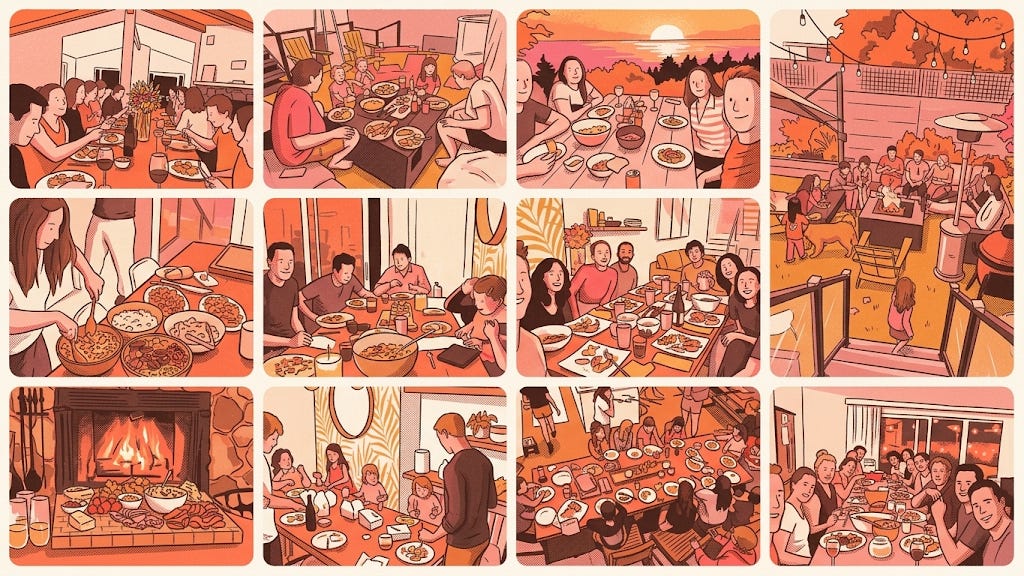
I already host a recurring dinner with people I love, so I don’t need an agent to invent the party. I’d hand it everything around the party that isn’t the party.
The logistics. Check the day before that everyone can still make it, because plans change and someone always cancels at the last minute. Ask what people are bringing, tell me, and suggest something I could cook that goes with it. Or flip it: ask me what I feel like making and pass that along, so my friends can pick something that complements it. Ping me if what I want to make means a grocery run.
The things I forget. There is, right now, a bag of hand-me-down kids’ clothes in my garage that I’ve meant to give a friend for three visits in a row. Every time, it’s a long fun night, they head out, and I remember the bag the next morning. An agent that knows the bag exists and mentions it while they’re putting on their shoes would earn its keep on that alone. Same for dietary restrictions. Same for you haven’t seen them since June.
The people I want to be deliberate about. I’d love to hand an agent a short list and say: make sure I see these people every four to six months. If my evenings look open one week and it’s checked with their agents that theirs might be too, suggest a dinner. If my week has been brutal, suggest ordering in and give me three options instead of a recipe. For people I see less often, or a networking dinner I want to make count, remind me what we have in common, surface a photo from the last time we were together, hand me a couple of conversation starters so I walk in excited instead of scrambling. And every so often: these two friends of yours would like each other, want to put them at the same table?
What I wouldn’t hand over is the cooking. Which is technically logistics, and an agent would happily solve it for me. I know there are people out there building cooking robots. I’m just not their target audience, because I get real joy out of it. The whole exercise is finding the parts of a night I enjoy and making those better, which is a different job from finding the parts that could be automated and automating them.
How I square it
By carving the time out and being a bit unapologetic about it. When friends are over, the phone goes away and I try to be fully there. If it’s been a jammed week and I still want to see people, I’ll occasionally excuse myself for a minute or two every so often to unblock an agent so things keep moving. I’m a decent multitasker, and the agents are patient - and more importantly, my close friends are understanding.
Mostly it works because the building fits around the people, not the other way around. I prep appetizers while an agent runs. I squeeze in a bit more after everyone leaves. I save the heavier work for the evenings nobody’s coming over. The reason to have people over at all is that it pulls me out from in front of the computer and makes that time non-negotiable.
And I’d argue it makes me better at the building. I come home from a dinner with ideas I would not have had at my desk, and those are usually the ones that turn into the next side project which then makes me think differently at work.
We’re all racing to be more productive right now. Don’t get me wrong, I’m doing it too, and I have the agents to prove it. But it’s worth stepping back every so often and remembering what the productivity is for. For me it’s family and friends. Make the memories, enjoy the dinner, be in the room.
When I go looking for my happiest memories, none of them involve sitting in front of a computer doing work. The outcomes of that work are great. But the outcomes I’m proudest of were shared with somebody anyway, and the memories I actually keep are from the nights I went out or had people over. People are the part that matters. The agents are there to make more room for them.