


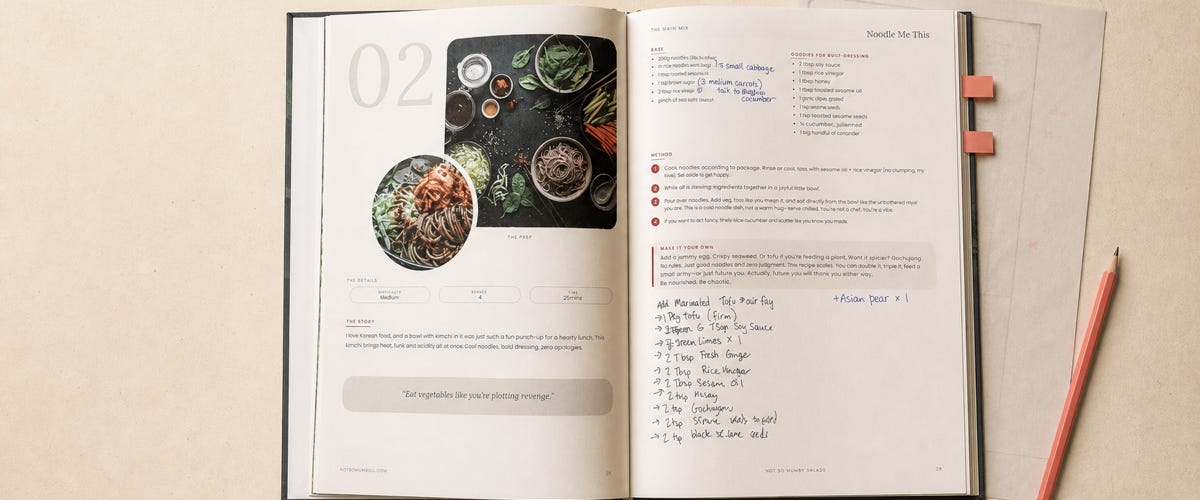
For close to a decade, one of my favorite creative projects lived in a single Google doc.
11-point Arial font. Text and bullets. No pictures. Just a very long list of elaborate salad recipes - Thai, Mediterranean, Korean, whatever I happened to be obsessed with at that moment. Visually, it may be the saddest thing I have ever made. But the content - some of my best work!
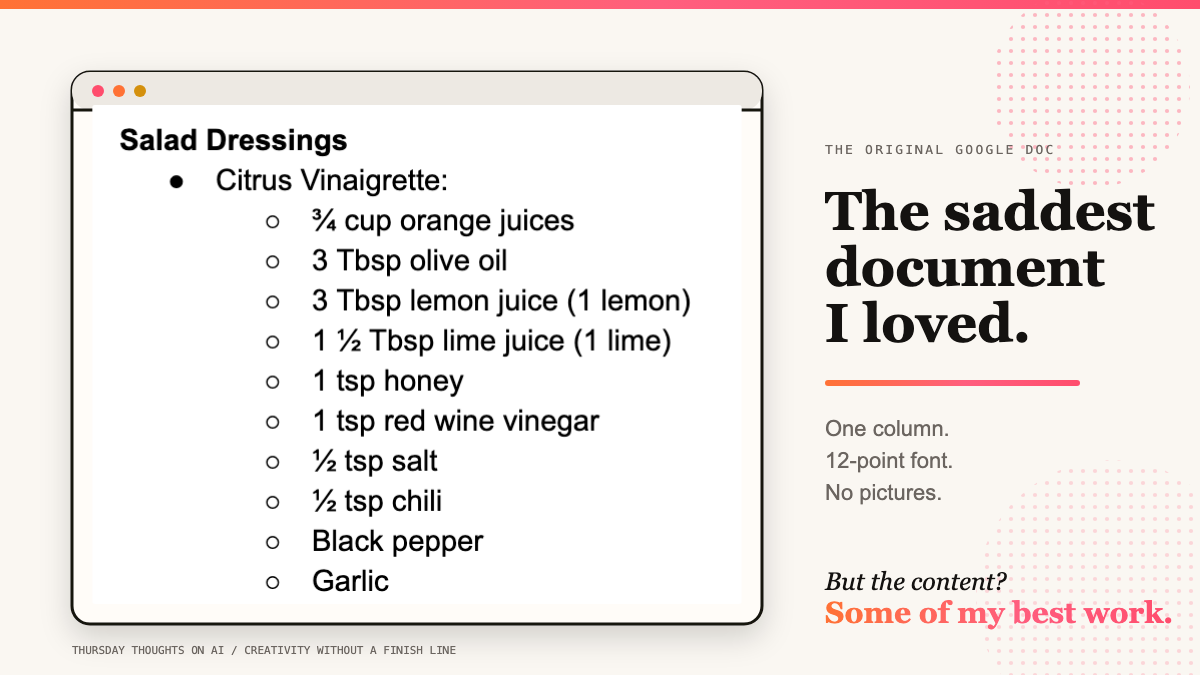
The whole thing started because I love a really good salad, and the best salads are almost never simple. So I began collecting recipes, making them for friends and family, and iterating on them as I went. At some point my family started asking me to turn them into a book. This came up often enough that it became a holiday tradition: “When are you making the salad book?” And every year I had more or less the same answer: one day.
For years, the doc sat there as one of my many side projects. I referenced it, added to it, and thought about it a LOT. But it remained a sad looking Google Doc. Then, over the past couple of months, it started morphing into something new.
The doc starts migrating
The first move was from Google Docs to Google Slides so I could add images to the recipes, mostly because a recipe collection without pictures is basically a spreadsheet with feelings [full disclosure: I asked AI for this metaphor because I couldn’t describe it better myself, and now I can’t stop laughing at how absurd yet accurate it is.]. After years of using the doc, I realized I really wanted to see the food to help get me excited about the salad I was about to make. The problem is that, while I make a great salad, I do not take a great photo of a salad. As image models improved, the pictures improved with them. Suddenly the thing in my head could look a lot more like the thing on the page.
Then I decided it needed a website, but not just any website, a website that packed a punch as big as the salads it contained. The first versions of the site felt flat, which is when I decided to start actually building a brand for the project. Not So Simple Salads got a palette, fonts, a voice, and a whole personality. This is probably revealing: creating the brand book was not a chore I had to finish before getting back to the “real” project. It was one of my favorite parts. Once the project had a personality, I had a much easier time making decisions about everything else.
That’s when notsosimplesalads.com was born - my record finally got a home outside my Google account.
And then I tried the thing my family had actually been asking for. I handed the recipes, the brand book, the images, and a slightly chaotic pile of references to a coding agent and asked it to help me design the book. I pulled ideas from Stitch, Pinterest, Google image search, and the cookbooks on my shelf to help steer the design of the pages. I kept reacting to what came back - this layout, not that one; more editorial, less precious; bigger photos; try again. I wrote a dedication page. I made an about-the-author page, which felt extremely serious for a salad book, but why not?
A few iterations later, I had something real. I ordered a physical proof.
And then it arrived! A real cookbook, in my hands. After almost a decade of saying “one day,” that day had finally come.
The walls got thinner
I keep coming back to the fact that I did not suddenly become more creative. I did not start loving this project more. I had loved it since the first recipe went into that sad little document.
What changed was my ability to move the idea from one form into another.
A document became a deck. The deck became a brand. The brand became a website. The website became a printed book. Each of those steps used to require a different skill set, a different tool, and usually a lot more uninterrupted time than I have. Book design is a profession. Food photography is a profession. Web development is a profession.
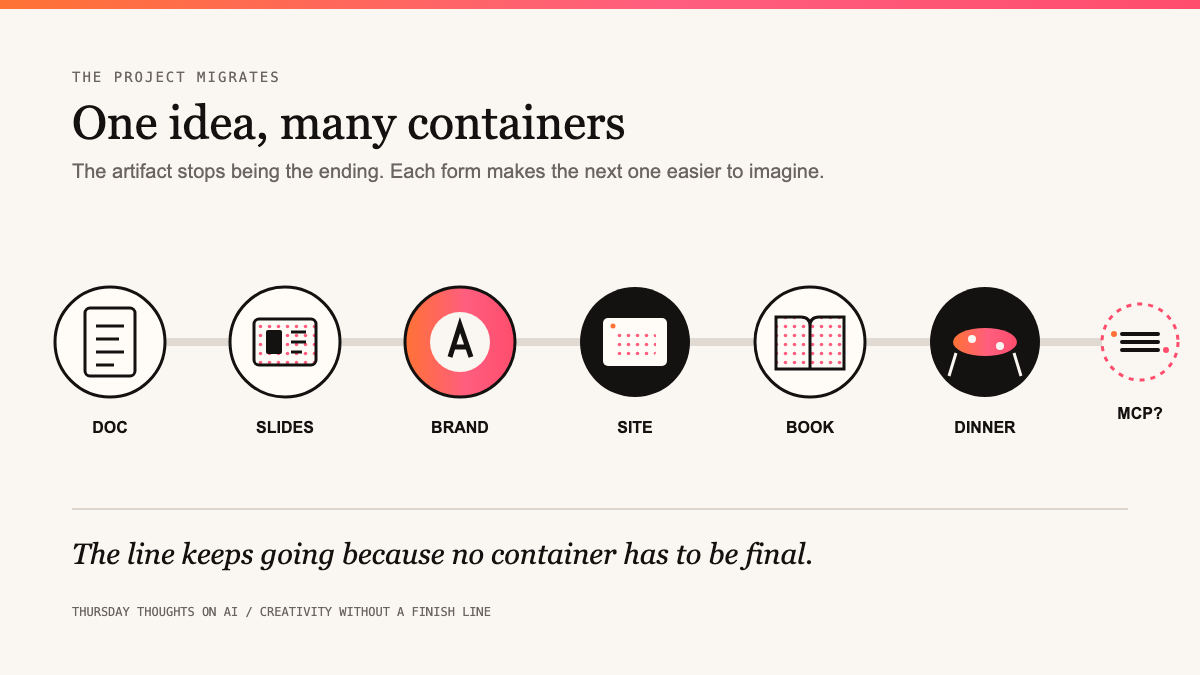
I think that is why the project stayed in the doc for so long. It was not stuck because I lacked ideas or motivation. I just kept running into the edge of what I knew how to make. Those edges are much easier to cross now.
The artifact is not the finish line
I assumed the printed cookbook would feel like the end.
That was the plan: make the book, give it to my family, feel very accomplished, and move on to one of the other 10+ side projects waiting for my attention.
Instead, the book showed up and immediately gave me things to react to. Some recipes needed another pass. Some layouts looked different on paper than they did on a screen. Some dishes made me think of entirely new salads that should have been included. The finished artifact became a very useful draft. I have also been riffing on recipes with AI. To be clear, its first suggestion is often not right for my taste. But telling it, “No, absolutely not, this is the blandest thing I’ve ever tasted,” forces me to explain what I actually want. Sometimes disagreement is the fastest route to a better recipe.
The website is not done either. I keep adding things because adding things is fun. And because there is a whole world of delicious salads to uncover.
So I no longer think of the book, site, or brand as endings. They are things I can react to. And that reaction is what keeps opening up the next version of the project.
Off the screen
The part I did not expect was that all of this digital acceleration would push the project off the screen.
I love hosting. So naturally, the cookbook has started turning into dinner parties.
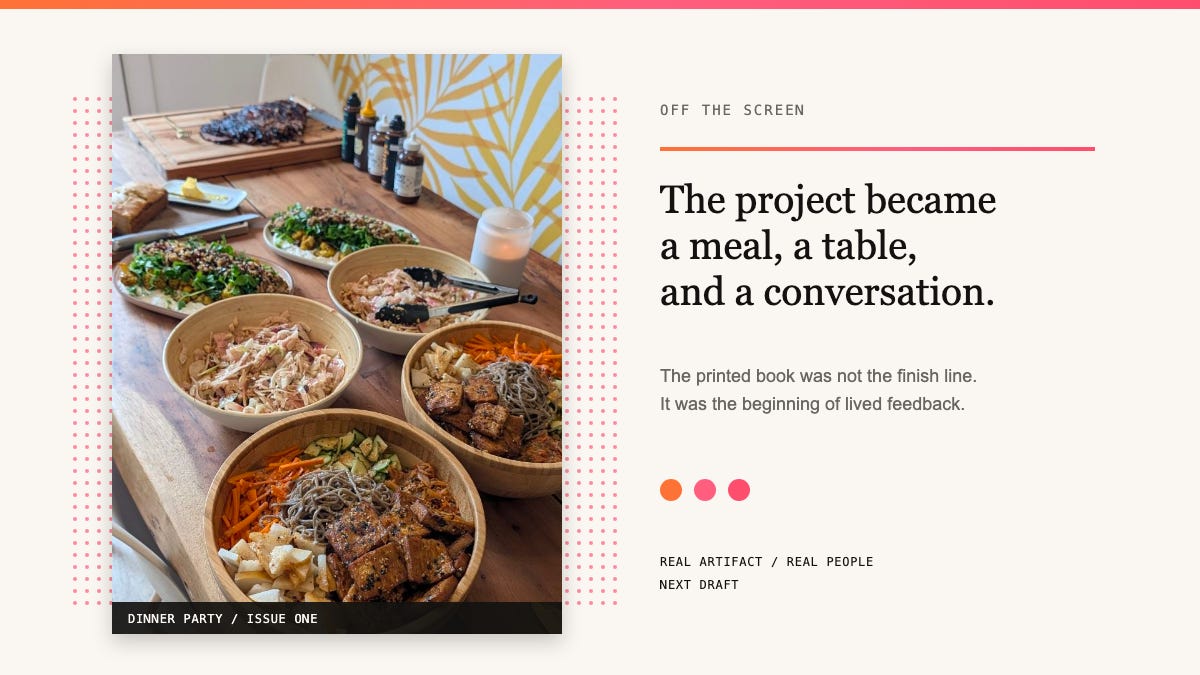
My copy is already accumulating scribbled notes in the margins. I watch someone react to a dish and think, oh, that needs more acid. Or someone mentions an ingredient and I immediately want to build a new salad around it. Issue two is apparently being written by people sitting around my dinner table or hanging out in my backyard.
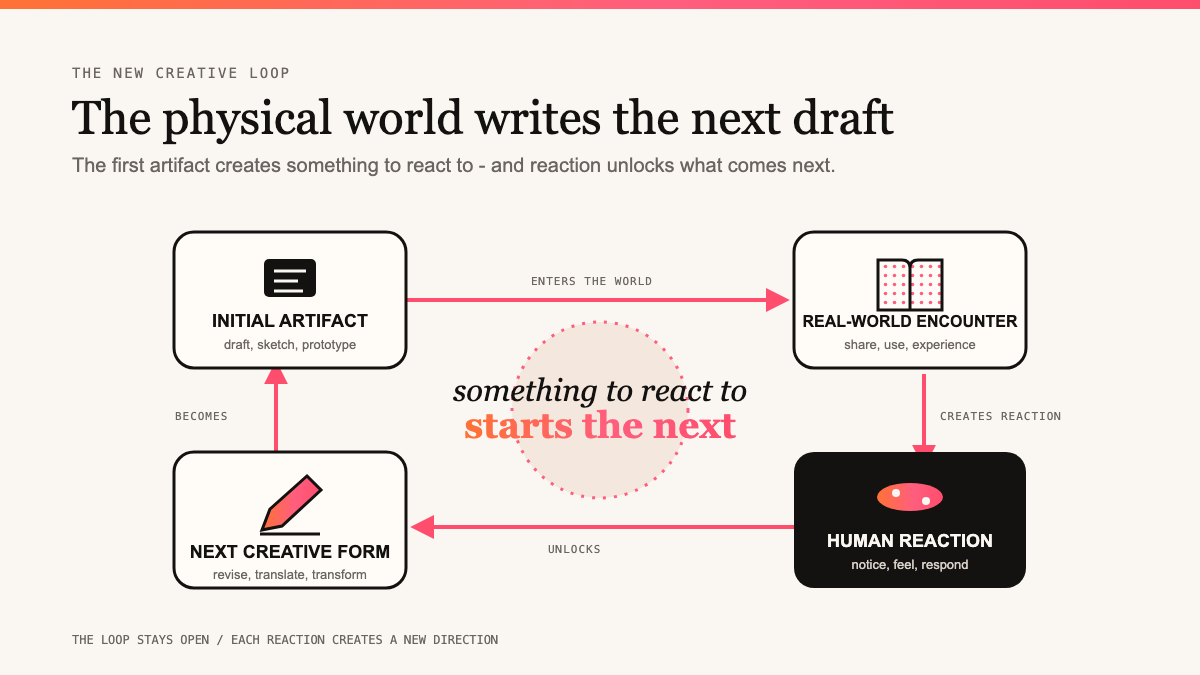
That is the loop I am interested in now. The initial artifact creates something real to respond to. The response unlocks another idea, which may take a completely different form. A Google doc becomes a book. The book becomes a dinner party. The dinner party starts writing issue two.
The question I did not see coming
I shared some of this on X, and someone asked whether there was an MCP server for the recipes - something their own agent could call while they were cooking or building something else.
There is not….at least not yet. But I have not stopped thinking about the question.
Mostly because it suggested another form I had never considered. The recipes would no longer just be something people read on a site or in a book. They could become an ingredient in somebody else’s creative process. The doc became a deck, then a brand, a site, a book, and a dinner party. Maybe it becomes an endpoint next. Honestly, who knows.
I do not know if I will build it. I also do not know what would come after it if I did. A few years ago, that would have made the project feel unfinished. Now I think it may be the point.
Somewhere in my Google Drive, the original document is still sitting there. 11-point Arial font and no pictures.
I still love that version. It is where the whole thing started. But the project does not live only there anymore, and I love what it’s become.
As someone who loves to cook, build recipes and shares them with friends and family, I found this read very close to heart! Thanks for sharing the journey of your Google doc to potentially endpoint!!