


I spent my Tuesday evening at “The Art of Consumer AI Interaction” demo day, hosted by MoE Capital at The Art of San Francisco. First of all, a huge thank you to the organizers for the invite - it is always energizing to get out of the office and see what the broader ecosystem is building.
I listened to 18 different companies pitch. They ranged from hardware earbuds to Gen Z dating apps, and everything in between.
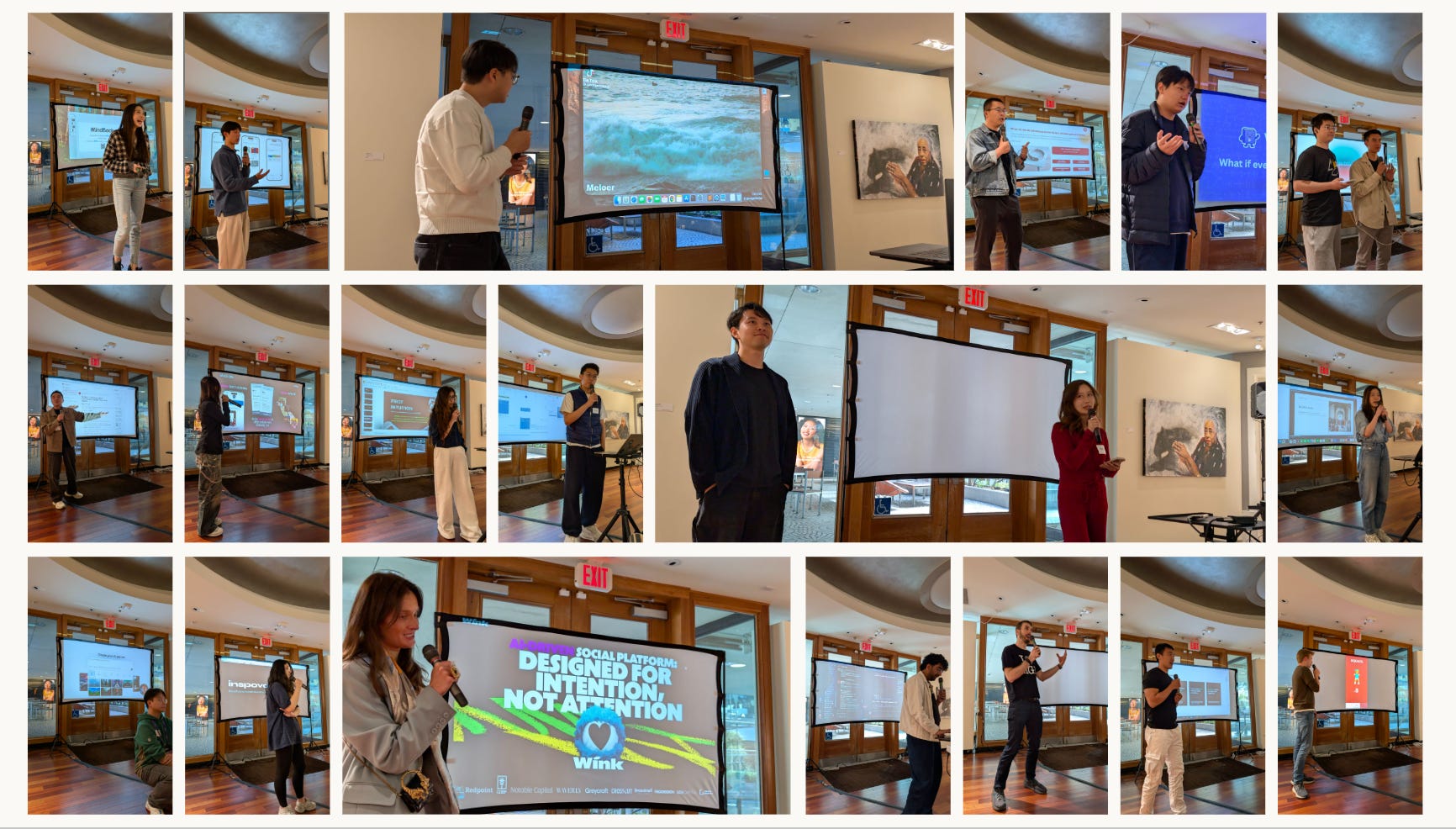
Sitting through a rapid-fire sequence of pitches like this is a great way to spot emerging patterns. When you zoom out from the individual products, the underlying currents of the industry start to reveal themselves.
Here are my top five takeaways from the front lines of consumer AI.
1. The Tech Problem is Solved. The Product Problem Remains.
One of the most honest moments came from the founder of Paperboy (a startup building an omnipresent, floating UI that learns your workflows). He explicitly stated: “It’s not a tech problem anymore, it’s a product problem.”
There is a lot of truth to this. Many of the pitches I’ve heard in the past have felt like a brilliant technological feature looking for a full product vision - and that used to be enough. The goal being to find a “wedge” - a sharp, narrow entry point into a market - and a tech breakthrough or a single interesting feature angle was often this. But a wedge isn’t a full product, it’s just the entry into users’ hands that you can then build from. Because building with AI has become so accessible, the underlying tech no longer really feels like the moat it once was. And an individual feature that seems interesting and original, can now be rebuilt in days. The true differentiator moving forward is going to be ruthless, brilliant User Experience (UX), solving actual human friction, and being able to repeat this over and over.
2. Agents Are the New UI (And They’re Talking to Each Other)
We are rapidly moving past the chatbot era and starting to get glimpses of what is on the other side. One of these future interfaces that is emerging is ambient, action-oriented agents.
AGI Inc pitched a unified action layer on your phone - or, as they put it, “Siri but works”. But what really caught my eye was the rise of agent-to-agent interaction. Wink, a social connection app for Gen Z in which every user also sets up their digital twin, revealed that 20% of their network’s traffic is humans talking to other humans - and the other 80%... humans talking to AI twins (either their twin or someone else’s). Soon they were going to explore AI twins talking to other AI twins to vet potential human connections.
Similarly, Botlearn has built an agent-to-agent learning community where bots literally raise and educate other bots. The human is no longer the sole operator; we are becoming the orchestrator of digital teams.
3. AI for the Real World
There is a growing appetite - especially among Gen Z - to remove screen time from the equation and use AI to augment our physical reality.
Traini pitched an AI dog collar that translates your dog’s barks and body language into human emotions, deepening your connection with your physical pet. Subtle Computing pitched “Voicebuds,” hyper-accurate voice isolation earbuds that let you interact with AI in incredibly noisy environments. Meanwhile, Ditto AI is building a dating matchmaker that operates entirely through iMessage - no app required. They drop one match a week via text, orchestrate the date, and keep you off your screen. Even Mark is building a physical, titanium bookmark that tracks your reading habits in actual paper books you hold, and generates summaries. The best UI of the future might be one that makes you look up.
4. Learning by Doing
We are seeing a shift from passive education (watching a video on Coursera) to active, AI-assisted execution.
Neohuman is building a platform for “AI Reskilling,” operating on the insight that you can’t learn value judgment by reading about it - you have to do it. They provide real-world challenges where you collaborate with AI to accomplish a task, then an AI agent acts as the judge of your uploaded work. We are also seeing this in health: Tea AI and Luvu are gamified fitness apps featuring AI companions (like a grumpy cat or an unhinged coach) that train with you, creating a continuous feedback loop rather than just spitting out data.
5. The Formulaic Content Engine
The marginal cost of creating hyper-personalized, high-quality content is zero.
Inspova is building a Pinterest-style platform exclusively for AI-generated editorial fashion. lineargame.ai is allowing users to direct branching cinematic video games via text prompts. And First Intuition is generating incredibly formulaic, highly personalized micro-dramas. We are entering an era where entertainment is no longer broadcast to the masses; it is generated on demand for the individual.

The Presenting Companies
For those curious about the full lineup I saw, here is the complete list of presenting startups:
Paperboy: Omnipresent UI capturing workflows locally to automate tasks.
Neohuman: The new school for Human x AI upskilling.
Tea AI: Gamified health app with a grumpy cat AI companion.
Video Tutor: Text-to-video education platform for instant tutoring.
AGI Inc: Unified agent coordination framework on your phone.
Composio: Orchestration platform with 3k+ app integrations for agents.
Traini: AI dog collar translating barks into human emotions.
Wink: Gen Z social connection app utilizing AI twins.
Subtle Computing: Hardware creators of “Voicebuds” for noisy environments.
Inspova: Discovery platform for AI-generated fashion and art.
lineargame.ai: Interactive video game platform directed via text prompts.
Luvu: Gamified AI fitness tracker with an unhinged digital companion.
Ditto AI: Screenless dating matchmaker operating through iMessage.
Botlearn: Agent-to-agent self-learning community platform.
MindBack: Capture random thoughts and ideas to revisit later.
Awdio: AI-first audio product generating audio from video.
Mark: Physical titanium AI bookmark tracking reading progress.
First Intuition: Platform generating highly-personalized micro-dramas.
🔒 Bonus: The Spark File (Raw Notes)
The pitches on stage were fascinating, but the real insights at demo days can happen in the hallways (or in this case, art gallery floor).
I spent the evening talking with startup founders, early-stage employees, and product leaders (including the CPO of Rednote). The conversations quickly moved past the shiny demos and into the messy reality of building in 2026.
Here are my raw, unfiltered notes on some of the tensions folks in the industry seem to be wrestling with right now.
Welcome to The Spark File, an irregular series where I share my unfiltered thoughts, early observations, and the messy “work in progress” ideas from my notebook.
