



Google rolled out Gemini 4 Argon on Tuesday, and I am excited to share some of the things I have had fun building with it. Not evaluating it. Not benchmarking it. Building with it, the way you pick up a new toy or tool and see what it’s capable of.
Here is what I posted when it launched:
Every leap in model capability opens up a whole new set of possibilities for what can be built. As a product builder, that’s what excites me most about Gemini 4 Argon. Not just what the model can do today, but the entirely new product experiences it makes possible tomorrow. So much more to build!
The ceiling on what one person can build in an evening has moved, and it moved a lot. Both in terms of speed of building, and, more importantly, what is possible to create. The interesting question is no longer “can the model do this?” It is “what should exist now that it can?”
This post is meant to get you inspired. First, a few things other people have made this week that made me stop scrolling. Then three small things I built for my own kids. One note before we go: everything of mine here is a quick experiment, not a thoughtful build-out. None of it is polished. But that is sort of the point. Even the rough first attempts give you a glimpse of where this is headed.
What people are building
My feed this week has been full of interesting things that people have tried with Argon. Four that stuck with me:
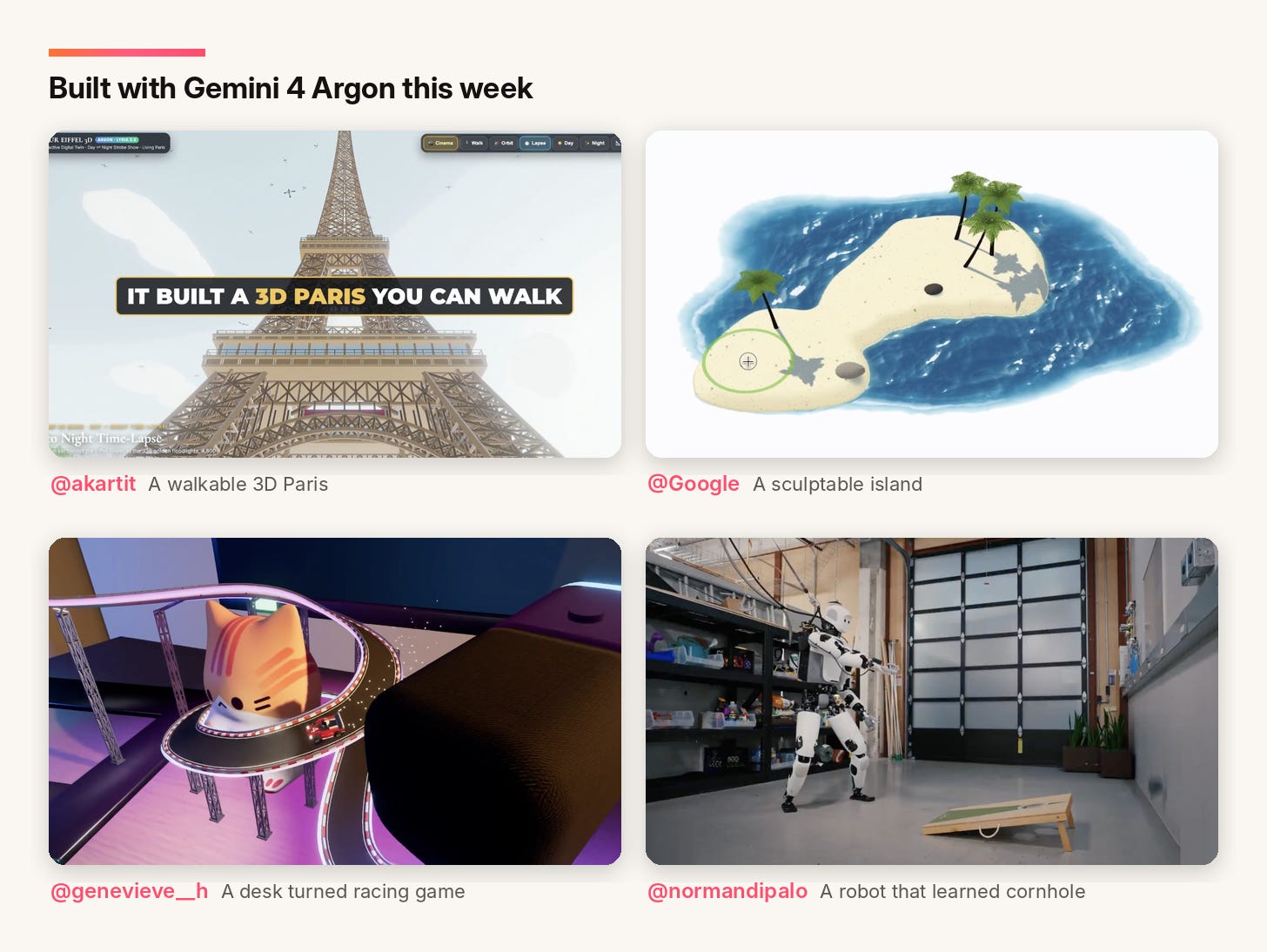
A walkable 3D Paris. AK gave Argon eight reference photos and came back the next morning to a browser-based digital twin of the area around the Eiffel Tower. Day turns to night, the tower’s floodlights come on, people and bikes and pigeons wander through. It cost him $48.97 and about three and a half hours of agent time, running OpenCode with Blender and Three.js. Eight photos in, a city out.
An island you sculpt with a brush. The Google team built an interactive sandbox in AI Studio where every brush stroke reshapes terrain, sand, and water in real time, with custom Three.js and GLSL shaders doing the physics. It looks like a toy. It is a real-time simulation engine that came out of a conversation.
A racing game made from photos of a desk. Genevieve took pictures of her home office and turned them into a playable racing game, with a track looping around a giant cat figurine and under the monitor arm. Blender MCP plus Three.js. The desk is recognizably hers.
A humanoid robot that learned cornhole from a video. This one is the wild one. Norman Di Palo and the team at Apptronik showed Argon a video of a person throwing bean bags. It then took control of the Apollo robot, generated its own simulation environment, did its own system identification, trained throws on the real hardware, and landed consecutive airmails. At the end they asked the robot to explain what it did, and it narrated the process with gestures it came up with on its own.
The common thread: curiosity, imagination, and thinking big. They started with a photo, a video, or a sentence, and the model carried it the rest of the way, including the parts that used to require a specialist.
Three things I made for my kids
Mine are smaller and more personal, which is kind of the point. These were not built to impress anyone. They were built because I knew that a specific small person in my house would love them.
1. Mermaid Lagoon, a memory game
If you have read this newsletter before, you already know my eldest daughter loves mermaids. So the first thing I made was a memory match game set in an underwater lagoon.
You flip shells to find pairs: Coral Mermaid, Purrmaid (a mermaid cat...the model made that one up), Narwhal, Sea Turtle, Dolphin, Octopus. The card art was generated with Nano Banana, each match gets read aloud with text-to-speech so she can play before she can read, and there is a Lyria soundtrack underneath. It scales from a 3x2 grid up to 6x6 as she gets better, has a two-player mode for sibling matches, and when you clear the board you unlock a sticker album where you can stamp the sea friends into your own lagoon scene and drag them around.
I did not design any of that. I described a game for a mermaid-obsessed kid and the model made the product decisions a thoughtful game designer would make. The difficulty ladder, the read-aloud, the reward loop at the end. Those were its ideas.
Don’t get me wrong, not every one of those ideas is a home run. But here is something I have noticed about my own creative process: it is often easier to react to an idea than to generate one from nothing. That is what this felt like. Brainstorming with the model, but not as a back-and-forth conversation. It sketched a dozen ideas, showed me a working version, and I now get to be the editor. Keep this. Cut that. Make the mermaid cat a little more cat...or introduce a mermaid dog?
2. Candy Kingdom Race, a marble run
All three of my kids will sit and watch marble runs on YouTube for longer than I care to admit (this is great for long roadtrips and plane rides). So I one-shotted one.
Eight named marbles (Ruby Red, Royal Purple, Sunshine Gold, Sapphire Blue, and friends) race through a candy-themed course: a musical lollipop plinko stage, elimination checkpoints, a giant rainbow vortex funnel, a gumdrop bumper sprint, and a final sprint to a checkered podium. There is a live leaderboard in the corner, and marbles get knocked out stage by stage until a champion is crowned. Ruby Red took the cup this time.
This one was a single prompt, which is what makes it interesting. I can already see the version where each kid names their own marble, or where the course is themed around whatever they are into that week. And there is a bonus: my husband loves physics, and appreciates that this is a good demonstration of that principle in practice. Everybody wins.
3. An interactive petting zoo
The last one is the most ambitious of the three, and the one I am most excited about: Sunny Meadow Petting Zoo. You walk around a little 3D farm with the arrow keys, and when you get close to an animal, it starts talking to you. Walk away and its voice fades out.
There are six animals, each with a name, a real breed, and its own voice: Mochi the Silkie Bantam chicken, Pippin the Nigerian Dwarf goat, Barnaby the Scottish Highland calf, Clover the Babydoll Southdown lamb, and a couple more to find (and yes, Argon decided on these 6 animals to showcase, which I love - because I would never have thought to pick such random animals). Each one tells you fun facts about itself in first person. Mochi explains why her feathers look like cotton candy. Pippin tells you about his rectangular pupils and 340-degree field of view. You can toss them a treat, give them a pet, and collect them all in a passport that tracks who you have met.
Under the hood it is a real stack: Nano Banana for the art, Blender for the 3D models, Three.js to run it in the browser, Gemini text-to-speech for the animal voices, and Lyria for the music. I did not wire any of that together by hand. I described a petting zoo where the animals teach you about themselves, instructed the model on what tools to use and it did all the plumbing.
What gets me about this one is that it is not really a game. It is a tiny educational experience, built in a morning while I was getting ready for work, and the “curriculum” is whatever my kids happen to be curious about. Next week it could be dinosaurs or the planets, and all the walking, talking, and collecting would just come along for the ride.
Your turn
Here is the thing I keep coming back to. Two of the three things above would have been a weekend project for a small team a year ago. The mermaid game alone has generated art, voice, music, a difficulty system, and a reward loop. This week it was an evening, and most of that evening was me playing it.
When the cost of building something drops that far, the limiting factor stops being engineering and starts with imagination. Specifically, the imagination to ask for things that did not make sense to ask for before.
A memory game for one kid, about the one thing she loves, that grows with her. A marble run with your children’s names on the marbles. A city you can walk through, built from your vacation photos. A robot that learns a backyard game by watching you play it. None of these are products...but that makes you start really thinking hard about what the actual products of the future will become.
So here is my invitation this week, to myself as much as to you. Pick the person you would most like to delight. Build them the thing that did not make sense to build last month. Then look at what you made and think about how creating it has changed your mindset.