


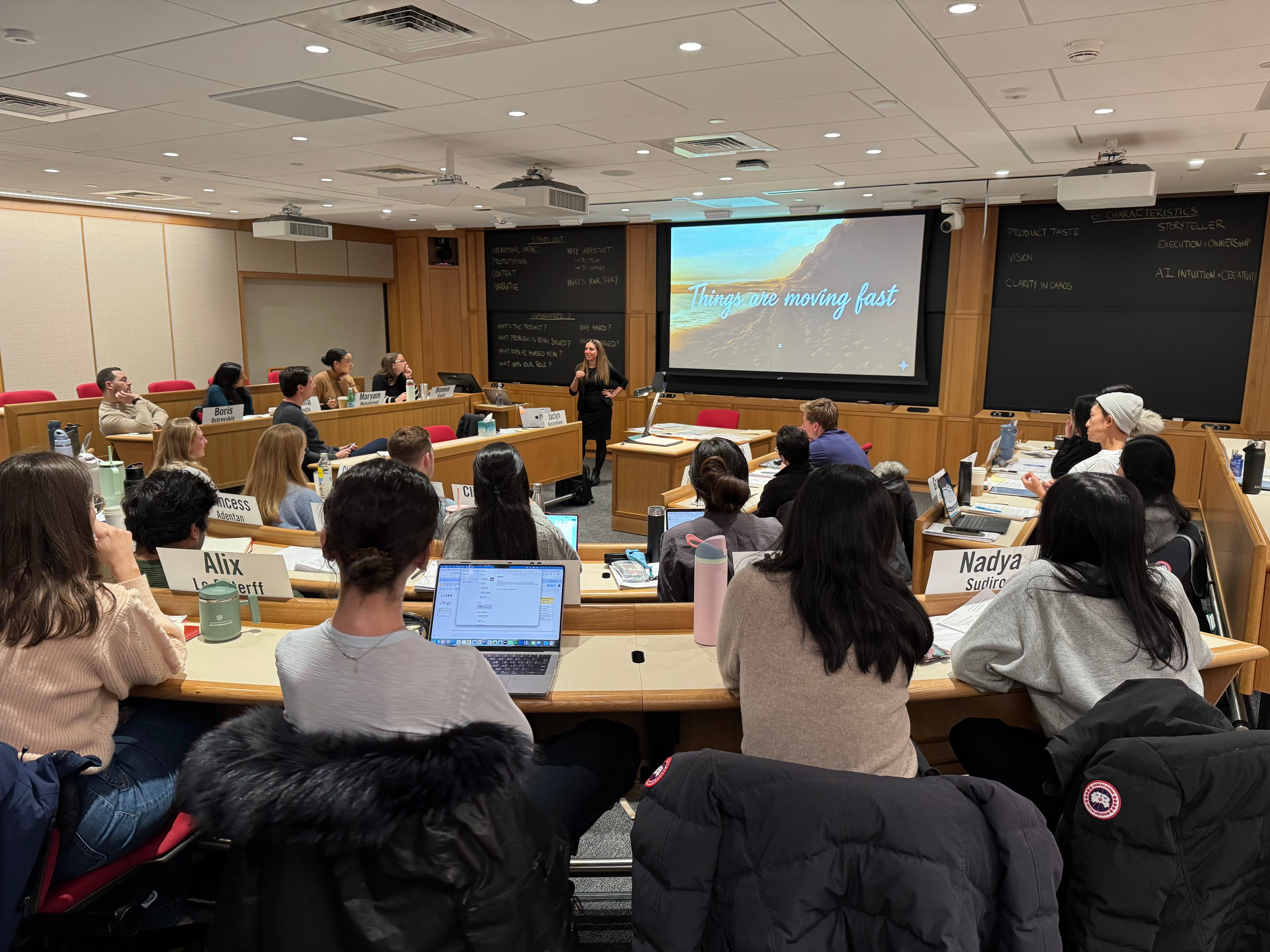
I had the privilege of visiting Harvard Business School last month to lead a session on resume writing for students interested in breaking into Product Management. We covered a lot of ground - from a case study I co-wrote to reviewing over 30 resumes. But the most interesting part wasn’t the resume formatting; it was the conversation about what it actually means to be an “AI Product Manager” in 2026. (Hint: at this point, that should just be all Product Managers).
The world has changed dramatically since I wrote my previous guides on this topic. As 2026 takes off, the signals I look for in a candidate have evolved.
Note: The fundamentals I wrote about before still hold true. You still need strong product sense, leadership skills, and the ability to execute. But in addition to those table stakes, one new signal has risen above the rest.
If there is a single thing you take away from this post, let it be this: Build Something.
The “Builder” Signal
One of the most common questions I got from students when I told them that they should be building was, “What should I build?”
My answer is simple: Build for yourself.
Don’t overthink the market opportunity. Don’t worry about launching on the App Store or getting 1,000 users. In fact, if you pitch me a side project as a serious business, I’m going to scrutinize it like an investor. I won’t just ask what it does; I’ll ask about your unique insight. Why did you think this was a massive opportunity? What is your GTM strategy? Why are you the best person to build this, and what is your moat?
But if you tell me you built a weird little app to solve a personal problem? That conversation is infinitely more interesting.
When you build for yourself - to explore, to learn, to scratch your own itch - you are demonstrating Curiosity and Agency. You are honing your product intuition and taste in the only way that matters: by doing the work.
The Great Equalizer
There is a sentiment right now that it is harder than ever to break into Product Management. And while the bar is higher, I actually see this as a massive opportunity.
Why? Because the bar has been raised for everyone.
This includes existing PMs. We are all going through a collective “upskilling” moment. The skills that made someone a great PM five years ago - writing lengthy specs, managing Jira tickets, mapping edge cases - are not the skills that define success today.
We are all relearning how to build in a new way that is still actively evolving. There is no “resting on your laurels” in 2026. This levels the playing field. If you are hungry, curious, and willing to get your hands dirty with modern tools, you can outpace someone with ten years of experience who refuses to adapt.
Case Study: The Death of the “Edge Case” PM
To understand why the skills have shifted so dramatically, let’s look at a specific example from my past.
Years ago, I worked on a feature called “Multilingual Assistant.” I was incredibly proud of it. But looking back, my pride came from my ability to manage sheer complexity, not necessarily velocity.
Here was the problem: We were building a setting on a mobile app that controlled your Assistant speaker. Users could choose two languages, and the Assistant would automatically detect which one was being spoken. Simple, right?
Not even close.
We had to map a web of dependencies that would make your head spin:
The Device Conflict: The Assistant language setting affected all your devices, including your phone. But your phone has its own system language. What happens if a user picks two languages that are different from their phone’s system language? Do we force a match? Do we pop a notification?
The Model Limitation: It turned out the model wasn’t equally good at all language pairs. If you selected “Language A” as your primary, you couldn’t pick “Language B” as your secondary if it was from a specific subset.
The “Impossible State”: What happens if a user already had a valid pair, but then updated their primary language to one that was incompatible with their existing secondary language?
I spent weeks writing pages of specs to handle every single one of these logic branches. I worked with UX to mock up every error state, every banner, every “greyed out” dropdown.
Back then, being a “good PM” meant obsessing over these details because the cost of getting it wrong in code was high. You had to be the safety net.
Today, I laugh at that process.
If I were building that same feature today, my workflow wouldn’t start with a spec doc. It might look like this:
Brain dump the intricacies into a voice note. “Okay, here’s the problem. We have a phone language, a speaker language, and a model limitation on these specific pairs...”
Ask Gemini to summarize the rules. “Based on this, generate a matrix of all valid and invalid states.”
Build an interactive prototype. I’d go into AI Studio and vibe code a functional settings page that actually implements that logic. I wouldn’t just describe the error state; I’d build it so the engineer can see exactly how it should behave.
The old way was about documentation to prevent failure. The new way is about prototyping to demonstrate success.
3 Signals I Look For Now
When I scan a resume today, I am looking for three specific things that tell me a candidate is ready for this new reality.
1. Evidence of “Building”
I want to see words like “prototyped,” “built,” and “deployed.” The clean lines between PM, UX, and Engineering are blurring. The job description has evolved from “defining requirements” to “shaping the product.” If you are still just writing documents, you are falling behind.
2. AI Fluency in the Workflow
Under the “Skills” section, listing “Microsoft Office” or “Jira” doesn’t impress me anymore. Tell me you are familiar with Google AI Studio, Lovable, Claude Code, Cursor, or Codex. These are the tools of the modern builder. They are a leading indicator that you are thinking the right way.
3. Thinking in Systems
Finally, I want PMs who are thinking about the types of products that are now possible. We are moving beyond “AI features” bolted onto existing apps. I want to see thinking around memory systems, agentic capabilities, and proactive context. I want candidates who know what is possible today, what will be possible next month, and what is still science fiction.
Sell Me on You (And Own Your Identity)
Finally, your resume - and your online presence - needs to be a pitch, not a receipt.
One of the biggest mistakes I see is candidates treating their resume like a chronological list of their career. But as a hiring manager, I need context. I need you to frame the narrative before I read the details. And I also don’t need to see every single detail of your past.
I look for resumes that start with a bold, impactful opening statement. Tell me your niche. Tell me your angle. Tell me the thing that makes you you.
Are you a Growth PM who obsesses over how to get attention and reach users?
Are you an Enterprise PM who loves use cases only large companies face?
Are you a Zero-to-One builder?
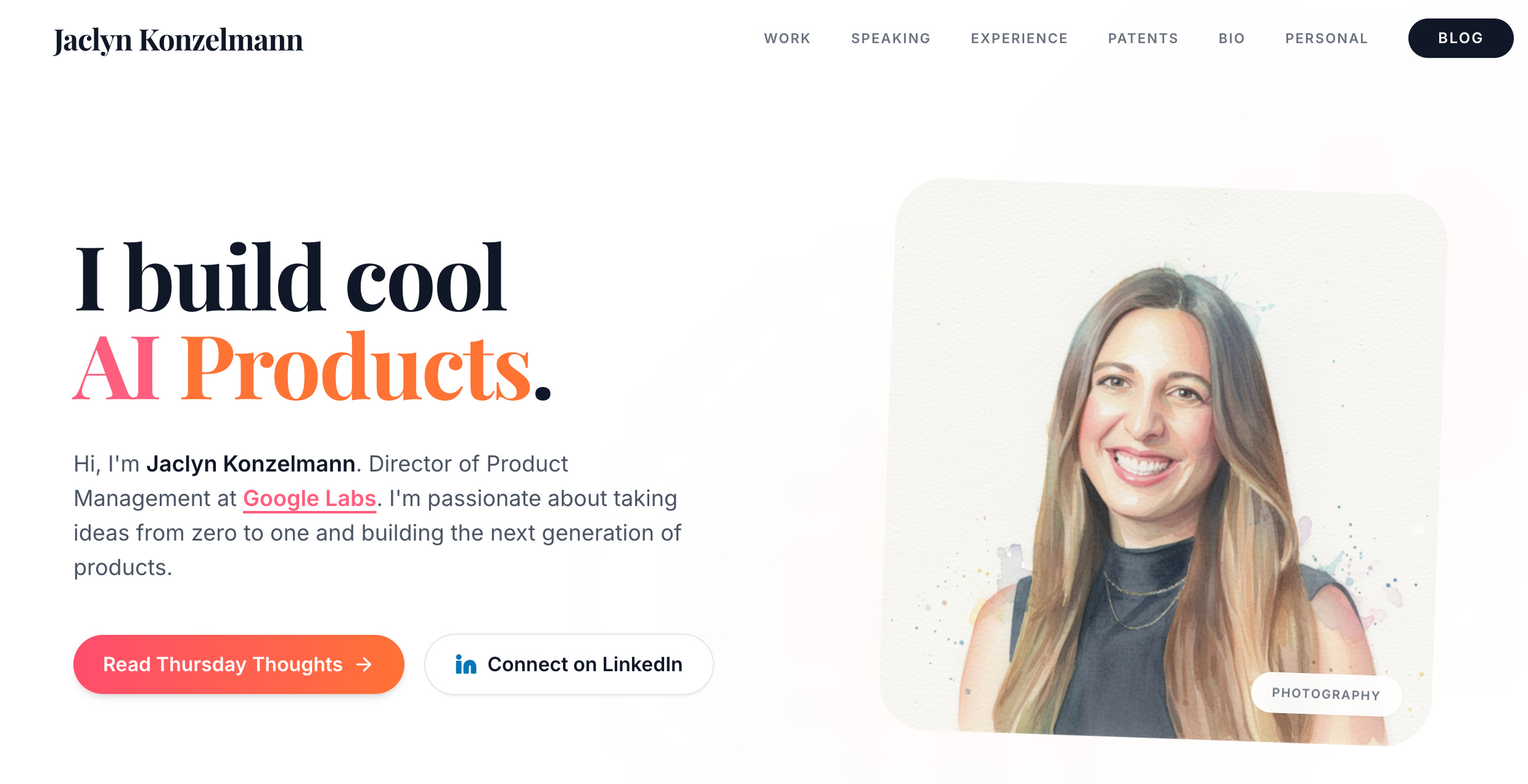
Every single aspiring PM should have a portfolio website, a GitHub link, or some artifact that shows me what they are capable of. When I built my own personal site, I didn’t hide the ball. I made it clear exactly who I am and what I do:
Don’t just build in public - think in public.
Own your online identity. Whether it’s a blog, an X account, LinkedIn, a portfolio site, or something else…show me how your brain works. The best candidates aren’t just doing the work; they are sharing what they built and their learnings with the community. This allows hiring managers to know you deeper. If the community is engaging back with what you’re building and thinking, that is a massive signal - for you, and for any future employer.
The Velocity of Change
The best way to describe how fast this role is changing is this: in the three weeks since I attended that class, the industry has shifted again. New models have dropped. New capabilities have emerged. And most notably OpenClaw has taken off (and had 2 rebrands in the process!).
We are all learning in real-time. I found myself needing to carve out dedicated time just to keep up.
So, don’t worry about being an expert. Worry about being curious. Show me you have the agency to learn, the drive to build, and the intuition to navigate a world that is rewriting itself every single day.
Thanks for this! I’m currently applying for AI PM roles while building my own product. It’s been a longer journey than I expected, but this post resonates with exactly where I am right now. Really appreciate the boost!
Thank you for the forward thinking to get us ahead. The insights are invaluable.