


I am in the thick of hiring right now, and as I comb through page after page, bullet after bullet, a stark realization keeps hitting me: it is incredibly hard to see the person behind the text.
Product taste is notoriously difficult to measure until you actually see what someone is capable of building. A standard bullet point simply does not help me understand if what you built was actually any good. Words are often too limiting to describe a nuanced product succinctly, and the traditional artifact of a resume strips away the humanity of the builder behind it.
I can’t help but feel like there has to be a better way to do this.
Recently, I chatted with a candidate who prepared a brief presentation showcasing their past work. They walked me through it—visuals, voiceover, and only the things that mattered. It was a breath of fresh air. It got me thinking about my own professional narrative and whether I could build a presentation that acts as a true product portfolio. My initial goal? Three minutes.
As I went through this process, I started collecting artifacts of my past: screenshots of product announcements, YouTube videos of podcasts and keynotes, and links to articles I had published. Hilariously, I even found the very first resume I ever used to apply for a job after graduating university. I present to you all, the resume that got me hired as a PM at Microsoft:
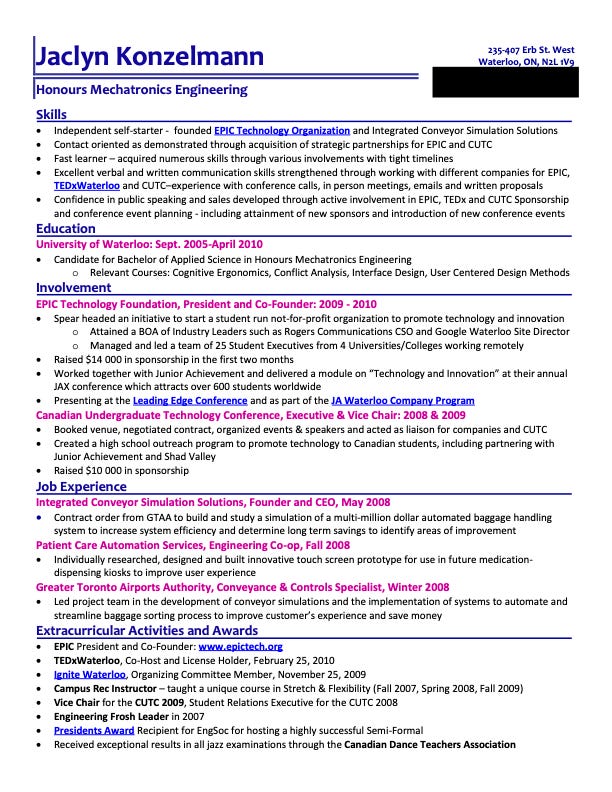
It features black, blue, pink AND purple font. It’s…something. I hope you can appreciate this artifact of my past as much as I did 😅. I promise you, everything I have produced since then is of a much higher caliber.
Equipped with this goldmine of context, I decided to take a systems thinking approach and leverage various AI agents and tools to bring my vision to life. Here is the end result:
…and here is how I built it, and what I learned along the way.
The Backstage Build Process
My goal was simple: create a brief, engaging video presentation that highlights my product portfolio.
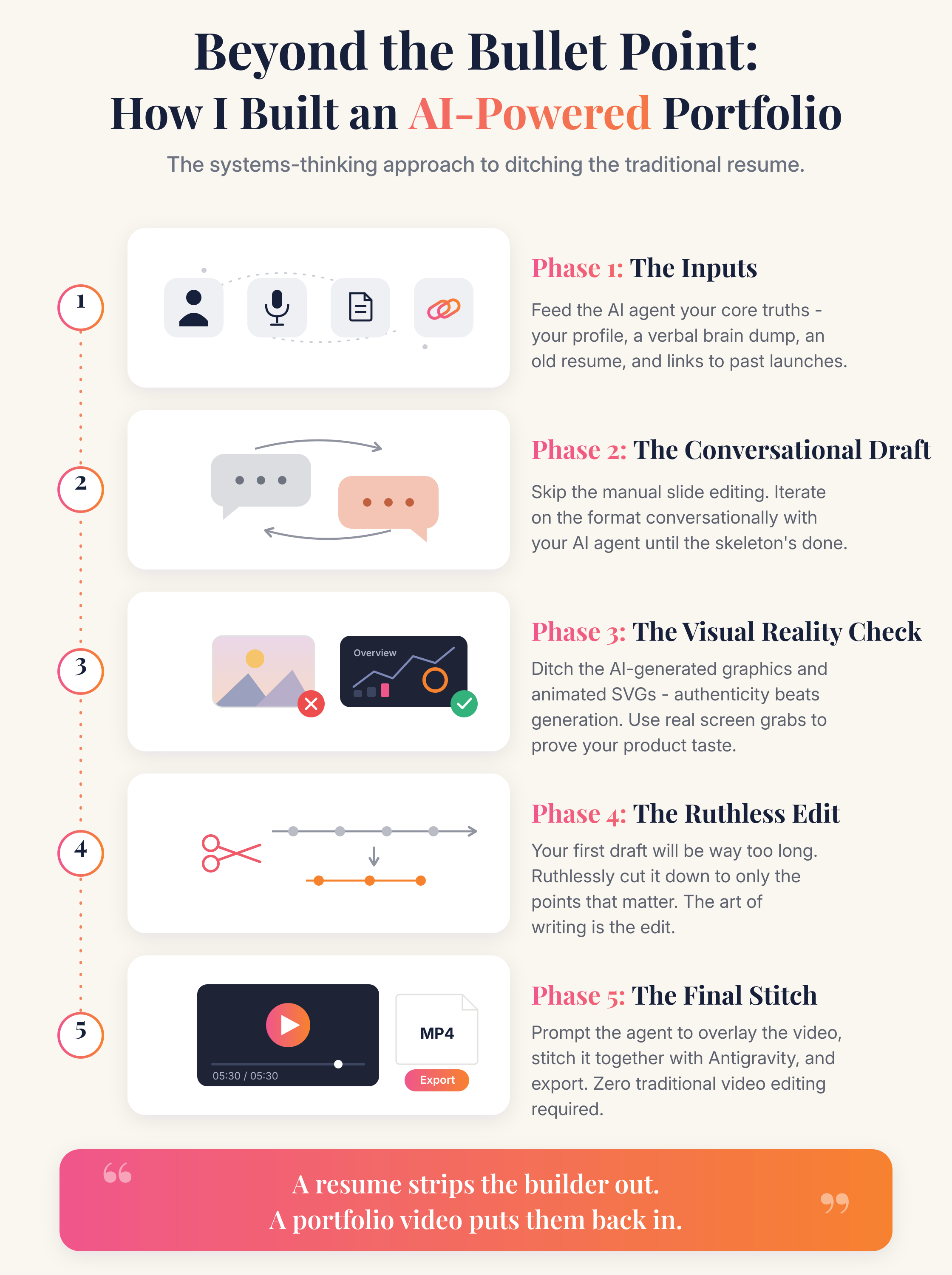
I started by working with an AI agent. I fed it my LinkedIn profile, a verbal brain dump of my experiences, an old resume, all the screenshots and links I’d collected, and my personal website to act as the ultimate source of truth. From there, we turned it into a presentation.
The first draft was…not great. We spent a while iterating on the format, modeling it after the style of my personal website. The craziest part was that this entire back-and-forth design process happened conversationally with the agent. I did not manually edit a single slide.
When it came to visuals to use in the presentation, I hit a few roadblocks. I started by trying to make a video montage of some of my past product launch announcements and screenshots. I loved certain aspects of it, but it lacked the visual excitement I had envisioned:
The examples I was basing this off of all used gorgeous full bleed imagery - screenshots of text didn’t evoke that same “wow” factor. It was also hard to see details in any of the images - and I was having trouble figuring out where I’d put it in the presentation. In the end, I decided to scrap this.
I also tried using generated images, but they felt disingenuous. Next, I tried animated Scalable Vector Graphics (SVG), but those also felt off:
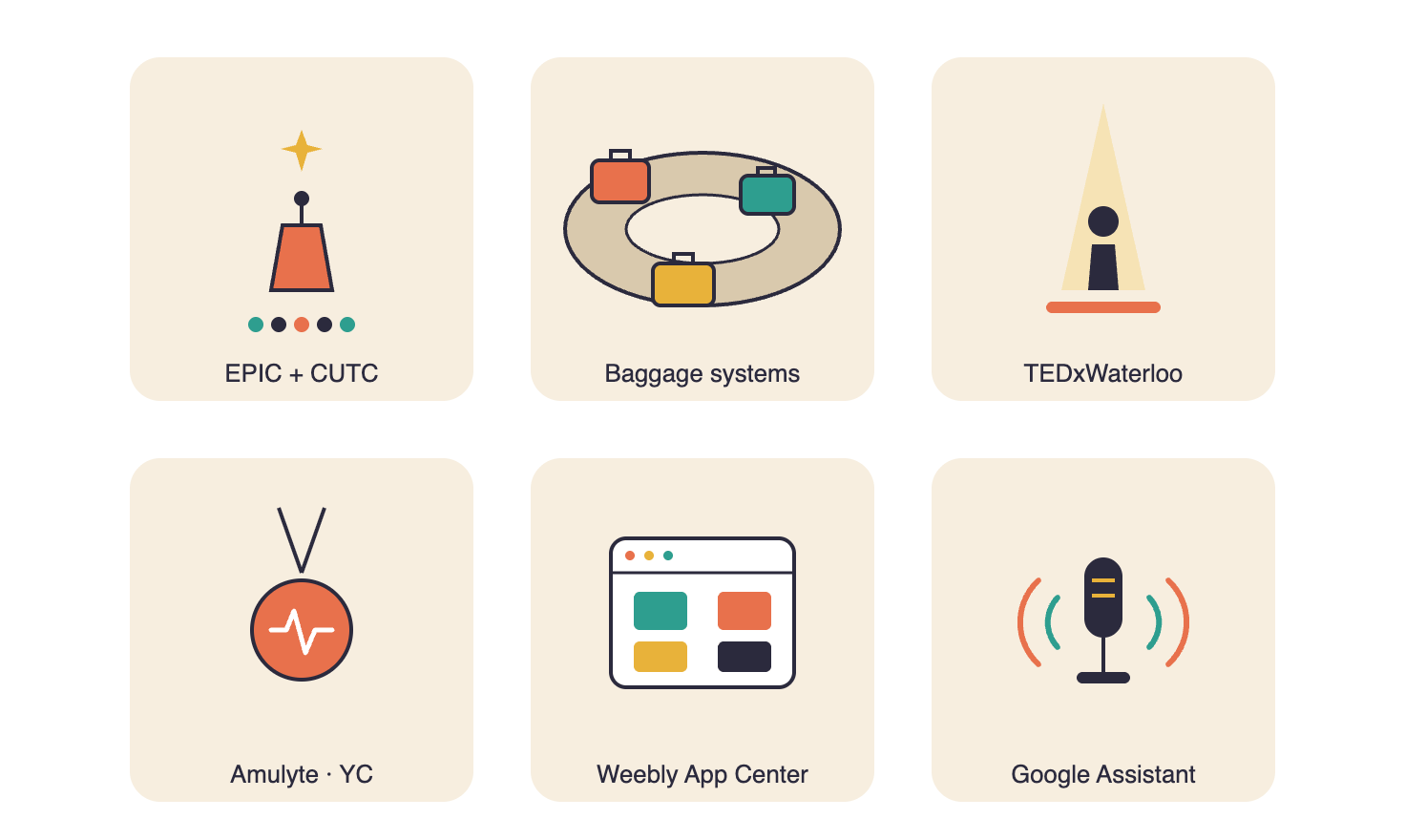
I quickly pivoted to using real images and screen grabs of the actual products I have built. It turns out, when you are showing off product taste, authenticity beats generation every time.
Next came the script. I spoke out loud, brain-dumping everything I wanted to say. The AI took my messy thoughts and helped me format them into a clean script. There was a LOT of editing at this phase, and I found myself feeling a sense of nostalgia and fondness as I recalled all the things I’d done. I wanted to make sure I touched on all these pivotal moments in my life and my career. I finally landed on what I thought was a great narrative, set up my computer to capture the video, hit record, and started talking. I ended up with a 14-minute monologue!
It was a far cry from the three-minute goal I had initially set.
The Art of Ruthless Editing
This is where I realized my workflow was a bit of a cobbled-together mess. I had far too many details, so I went back to the drawing board.
I ruthlessly scrapped what was not working, cut out entire sections, re-edited the narrative, and trimmed the presentation down to the absolute highlights. Then I hit record…and it was still too long. I repeated this process several times until I got the recording down to about five and a half minutes. It felt like the perfect length: concise enough to hold attention, but thorough enough to be true to the work.
Finally, I handed the recording back to my agent, prompted it to overlay the video onto the presentation, and used Antigravity to stitch it all together. I did not touch a traditional video editor or presentation software once in this entire flow.
What This Experiment Taught Me
Even if you are not currently job hunting, going through this exercise is incredibly valuable:
The productivity stack is unrecognizable. None of the tools I used to make this presentation are what I would have used two years ago, with the singular exception of Google Docs. The meta-lesson here is that the way we work has fundamentally shifted. This isn’t new, but it was interesting to reflect on it through such a complex workflow.
I can make things I’ve never been able to before. This presentation, the animations, the video, and the overlay - I don’t think I would have had the skills (or time to learn them) even two years ago.
The bar has shifted. My resume from over a decade ago is outdated compared to what I am now producing for objectively the same goal. The baseline for quality is higher than ever.
The art of writing lies in thrift. My natural storytelling instinct resulted in a 15-minute ramble. It takes ruthless, deliberate editing to distill a narrative down to five minutes. Do not assume your first draft is your final draft.
Reflection is a feature, not a bug. Taking the time to look back at past launches - like the Gemini API, AI Studio, Project Mariner, and even my time at YC and Microsoft - helped reinforce the core lessons I have learned over my career.
Adaptability through prompt engineering. The true power of this system is its flexibility. Now that I have the core presentation and script, it is a trivial lift to prompt the AI to add or remove slides based on a specific role or audience. You can instantly tailor the narrative and shift the color of your resume to highlight exactly what matters most.
The Future of the Resume
I do not think the traditional written resume is disappearing tomorrow. However, the expectations for how we present our work are changing rapidly.
Having a dynamic asset like a short, narrated portfolio that you can link inside a standard resume is a massive differentiator. It allows you to control the narrative, showcase your actual product taste, and inject the one thing a bullet point never can: your humanity.
And speaking of humanity - for my paid subscribers, I’m sharing with you the full 14 minute original voice narrative…
