



On Wednesday I gave a talk at The AI Conference in San Francisco called The Agentic Shift: how to build products when AI can actually do things. I’ve been living inside this talk for weeks, and I want to share both the talk itself and a little of what the day was like - behind the scenes.
The room
First - the room. I’ll be honest, I had no idea how many people would come. It was the AI Builders track, mid-afternoon, one of a lot of sessions. I walked over to Theater 2 to check out the room I’d be speaking in, and the session before me was pretty full. Then, when it came time for me to go on stage, even more folks entered. It was truly standing room only!
I had a lot of fun giving the talk, but even more fun hanging out with folks afterwards. I spent over an hour talking with people: builders, PMs, a few founders, and some folks who have been reading along on my Substack for ages - I don’t have a tidy sentence for what that meant, so I’ll leave it at: THANK YOU. A new tradition I’m trying to lean into is to replace Business Cards with selfies. So now I have a camera roll full of photos and memories. Turns out these are much more fun to look back on :)


The talk
Now - on to the talk…I submitted this talk back in February, and the topic I proposed was “how to build products when AI can actually do things”. By the time September arrived, can you build it had stopped being the interesting question. Anything can be built now. The question is should you build it, and what’s actually worth building.
So the talk is in two parts.
Part one is about what’s worth building. Three forces are moving at once (the models and the harness, the ecosystem, and users), and the four pieces of advice I’d give anyone building into that:
Push the frontier models and project out to where they’ll be when you launch.
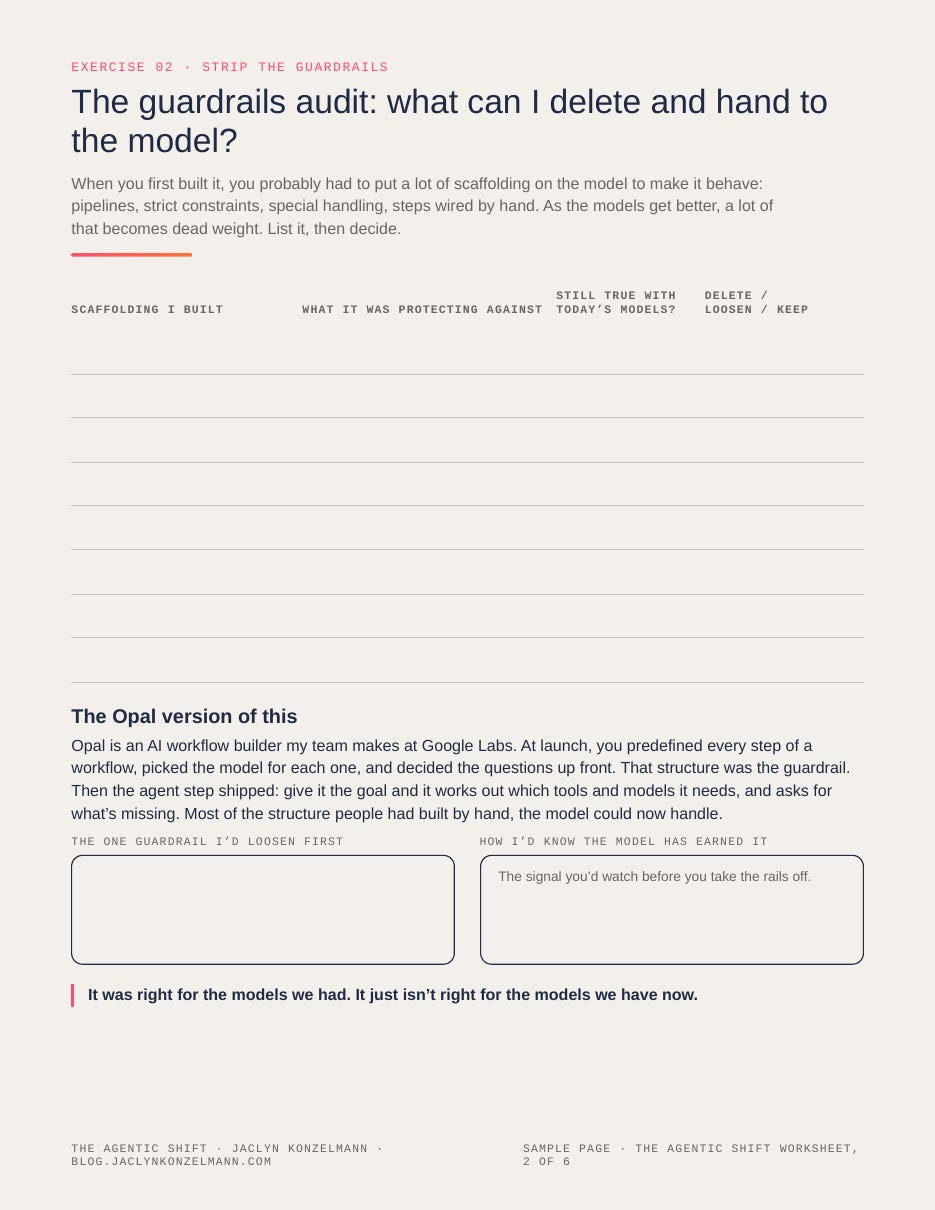
Strip the guardrails you built for last year’s models.
Keep the lessons, not the prototype. This was very timely given that we shut down Opal the same week as this talk.
You still set the goal. An agent will happily build you something plausible. Knowing the difference between plausible and good is the part you can’t hand off.
Part two is about how to build it. Every product now has two users, the person and the agent inside your product, and anything a user can achieve, your agent should be able to achieve too. I covered ideas like: your product is bigger than your UI and natural language might be a better way to reach the parts the interface hides. And the one that keeps me up at night: the agents using your product won’t all be yours. If you’re building a consumer product, chances are that somebody is going to send their personal agent to go use it, logged in as them (I did exactly that to Strava a few weeks ago). So the question becomes: when somebody sends their agent, why does your product still exist?
It opens with a 90-second film made by two synthetic voices arguing about whether a talk submitted in February can still be relevant in September (it’s a fun watch - I promise)
The Three questions
The talk ends with 3 questions I think are worth asking if you’re building something right now:
Would you build this today, knowing where the models will be tomorrow?
Can your agent do everything your user can?
When somebody sends their agent, why does your product still exist?
Like last week, I turned the frameworks into a worksheet. This one is six exercises, all new, nothing repeated from the PM Summit kit. The page below is the one I’d start with: the guardrails audit. List the scaffolding you built to make the previous models behave, and decide what you can delete and hand to the newer models now.
The other five are below, for paid subscribers, along with the PDF deck, the annotated deck and the full script.
Bonus: the full talk kit for paid subscribers
For my paid subscribers, I’ve put together everything behind the video again: the deck, the annotated deck with my notes and stage directions, the full script, and the whole worksheet.
