


Hi, it’s been a minute.
I owe you all an apology on that. Thursday Thoughts has been quiet lately because - well - I got caught up on being heads-down building. Both at Google and in my personal time. Pomelli recently shipped style transfer for Photoshoot - if you haven’t tried it yet, it’s super cool! Just take a look at some of the images it’s transformed for my Yosemite & Redwood coloring books:


Which brings me to my many side projects - some of these have turned into real things. The Mermaid Dots game I made for my five-year-old is now on TestFlight. And we now have a kid’s scary story podcast called Maya and the Fog that you can listen to on Spotify and YouTube!
Somewhere in all of this, the writing slipped.
But it isn’t because I ran out of things to say - quite the opposite. I’ve never had more to write about. Every week something changes in how I work, or in what the products we build even look like. In fact, I recently gave a talk on just this to a group of PMs in YouTube, and I thought it would be great to share it with all of you.
The question they wanted me to answer was one that seems to come up in every PM forum right now: if an agent can write the spec, build the prototype, run the analysis and draft the launch plan, what is this job of a PM actually for?
My answer, up front, is the line the whole talk hangs on:
Generative AI made writing cheap. It made prototyping cheap. It made code cheap. What it didn’t make cheap is good judgment.
The talk is in two parts. The first is about how the job has changed: why I wouldn’t write the forty-page PRD I was once proudest of, what I make instead (a one-page strategy doc, a deck, and a prototype), and the overbuilding trap I wrote about a few months ago and then fell straight into eight weeks later. There’s a screenshot of my own side project in there. Count the toggles (or don’t….it’s a lot).
The second part is about how the products have changed: the three forces that are all moving at once, why you don’t have one user any more but two (a human and an agent), the three questions I actually ask now about anything I own, and why the pitch for an agent is cheap while the experience is everything.
I recorded it so you can watch it the way the room saw it, slides and all. It’s about 28 minutes.
One note on how it was made, because it’s the talk practising what it preaches. I didn’t start in Slides. I recorded the call with the organizers, recorded myself talking through what I wanted to say, handed both to an agent and argued with it about the outline. Then we built the presentation. Then I recorded the talking-head version you’re watching, and an agent aligned every slide to my voice and cut it together. This is one of my primary workflows these days - and it’s not one I had a year ago.
While I was pulling the talk together I realized most of it is really a set of questions I ask myself, so I turned them into a worksheet: eight pages, one framework per page. Here’s the one I use most, the overbuilding audit. Print it and run it on whatever you’ve been building for more than a few days. Count the toggles.
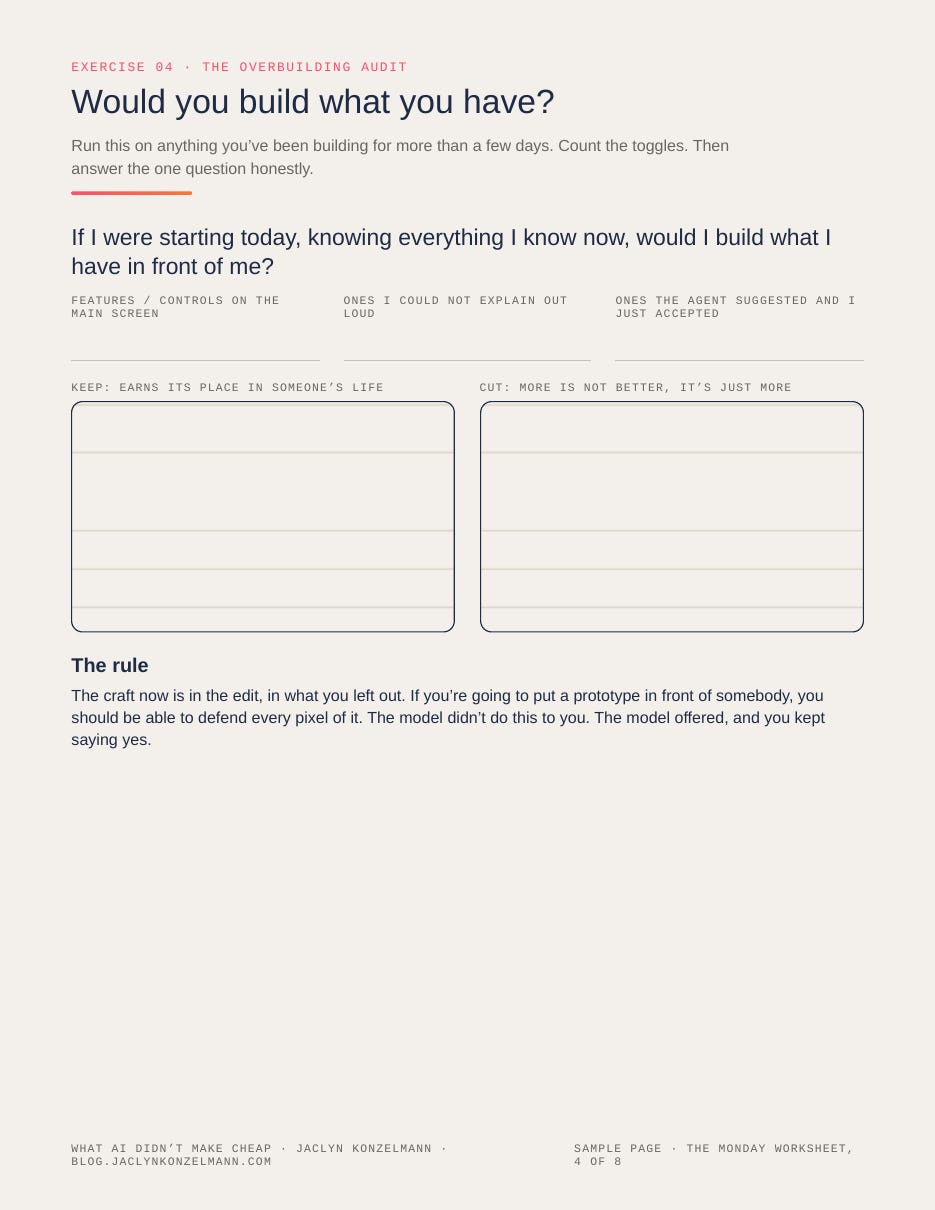

The other seven frameworks are below, for paid subscribers, along with the deck, the annotated deck and the full script (a total of 4 additional artifacts).
…and if you’ve made it this far - I promise I will get back to my writing - it helps me think, and there is SOOOO much to be thinking about these days!
