


I was at the YC Startup School Afterparty the other weekend, hosted by GDM and Google for Startups. It was an amazing event where I found myself standing for more than two hours in the same spot on a rooftop, talking with student after student about AI and startups. One of the most common questions I got asked was this: what does an average day look like for you?

Surprisingly (at least to me) I realized I didn’t have a good answer. I still don’t, really. Some days are back-to-back product reviews. Some afternoons I don’t open a single meeting invite and just sit with a doc, or a prototype, until it’s right. There’s no average day in my life right now of building 0-to-1.
But that isn’t a satisfying answer. So I did the only reasonable thing an AI PM would do. I pointed an agent at six months of my calendar and asked it to find the pattern I couldn’t immediately articulate based on my actual data.
Turns out, there was one - but it was better modelled as an average week, not day.
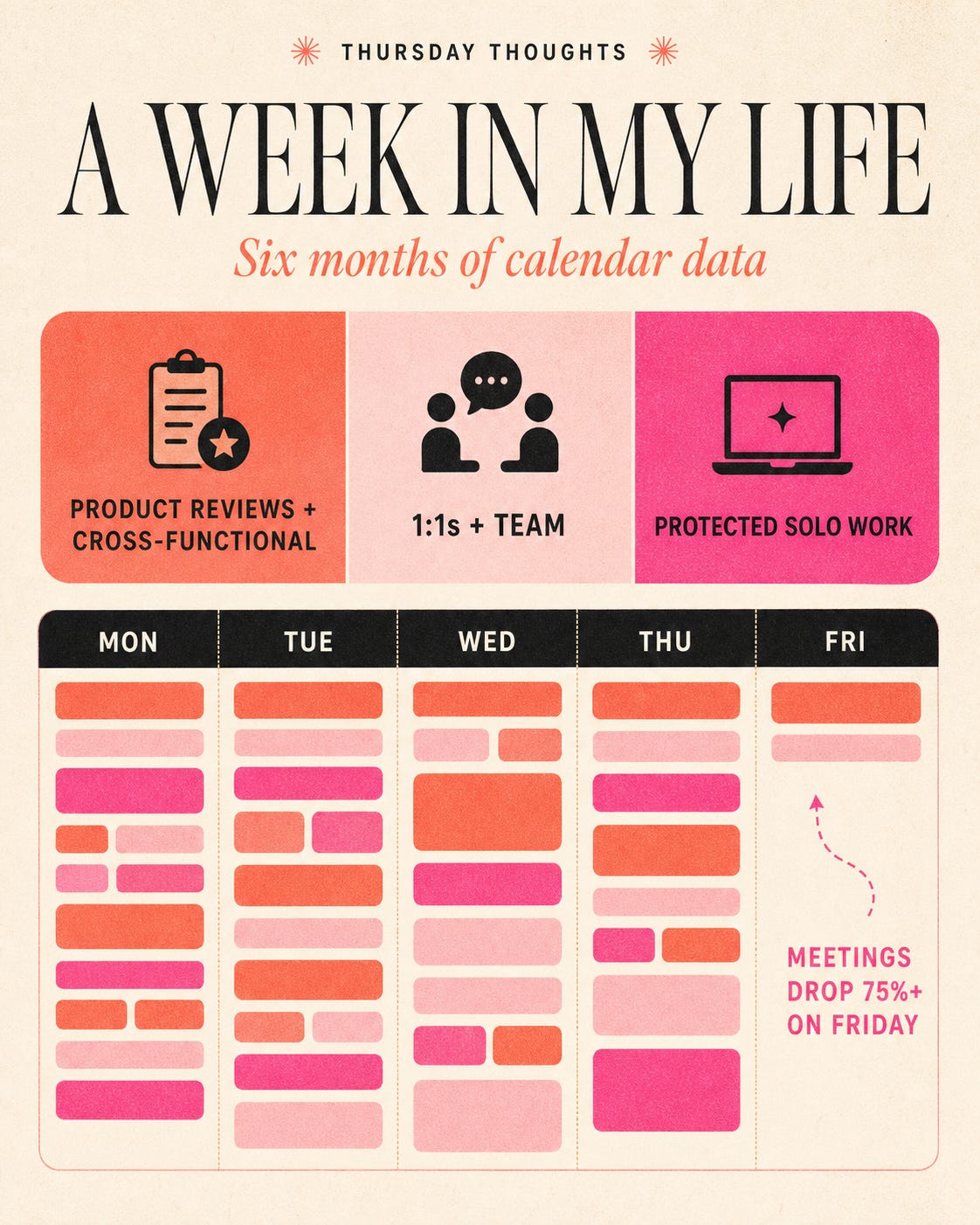
A Week in my Life
As it turns out, roughly a third of my week goes to product reviews and cross-functional syncs - the meetings where we steer direction, argue about tradeoffs, and keep a portfolio of early bets moving. Roughly another third goes to 1:1s - this includes coaching, unblocking, the fun job of keeping a team healthy, happy, and productive (side note: I was talking to a candidate this week and they told me that everyone they had asked about Google Labs described it as a joyful place to work, and I couldn’t be happier and more proud to be on this team). And the last third, protected as fiercely as I can manage, is solo heads-down work.
In the past, this time chunk would have been dedicated to thinking (alone), planning (alone), and writing a doc or making slides (alone).
These days I still do those things, but instead of doing it alone, I’m using AI as a thought partner. But a real chunk of this time now goes towards something else: building and testing. Opening a prototype myself. Testing a flow before I ask anyone else to believe in it. Vibe-coding something rough enough to be wrong in an hour instead of a week. And using the prototypes that my team has made so I can give more pointed feedback on what I like and where I think we could push on.
Friday is where this shows up most clearly. Meetings on my calendar drop by more than three-quarters. Almost five hours stay open, on purpose, for exactly this. I prefer Fridays to be quiet because it helps me digest the week and get a jump start on the next one - I’ve also learned that if I don’t guard this time, something else will fill it.
The same habit shows up off the clock, too. It’s how an evening turns into finishing a page of the Yosemite coloring book, or wrestling with why an image model refuses to give a cat three legs (my numerous side projects keep me busy). Different calendar, same muscle. I keep at it because the two feed each other - the thing I learned wrestling with a broken prototype over the weekend has a way of showing up in how I talk to my team about what’s possible to build now on a Monday.
It’s easy to let meetings fill your time, but these working blocks end up being some of the most important parts of my week, and the time I’d protect first if I had to cut almost anything else. Directing 0-to-1 work means I spend most of my time steering, but I believe that you can only steer well if you’re also actively building right now. If your hands are on the wheel of other people’s work, you need to know how to guide it well. Which is exactly why the solo third matters so much - it’s the only place left where I stay in direct contact with the thing itself, instead of just the plan for it.
Build to Learn made my list of principles for this year for a reason. My own calendar reflects how I’m living up to that principle. If you’re leading 0-to-1 work anywhere and your calendar doesn’t have dedicated time to be building yourself - go find it.