


I’ve been spending the quiet days between Christmas and New Year’s doing what most of us do: reflecting on the past year and trying to peer into the fog of the next one.
I went for a walk with my mom recently. She’s a retired entrepreneur - someone I deeply admire who built her own business from the ground up - and she asked me a question that I’ve been thinking about a lot lately:
“With everything that is happening with AI these days, what is the world going to look like?”
My honest answer? I don’t know.
That’s because the world is moving so fast right now. It’s easy to feel like you’re the only one struggling to keep up. You’re not. The most brilliant minds in the field feel it, too.

Trying to predict the end state of the AI revolution right now feels like asking someone in the era of horse drawn carriages to predict the societal impact of self-driving cars. We are in a moment of rapid, compounding change. The concept of “vibe coding” an app in an hour didn’t exist a few years ago - yet that’s exactly what I did earlier this break (it’s an app called Mosaix)…and then someone commented that they built something similar for a hackathon a couple years ago and it took 3 engineers a whole evening to do it!
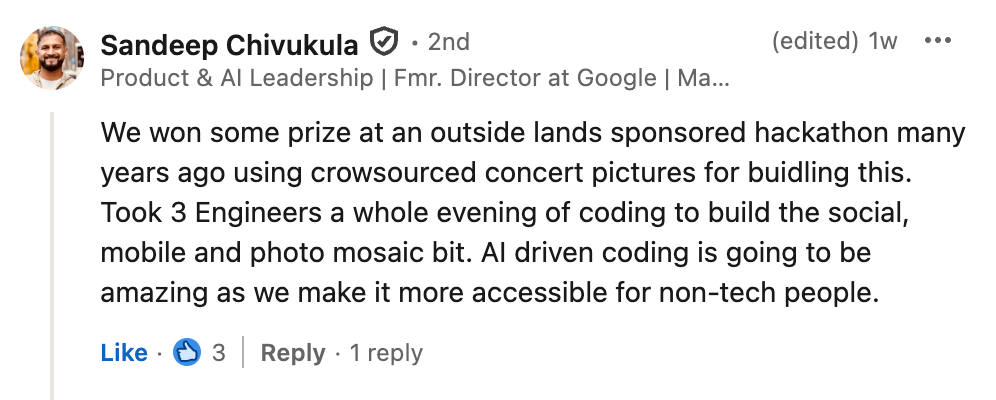
The idea that a single person could do the work of three engineers in less time and without ever having to write a single line of code…was science fiction back then. And yet, here we are.
I usually start every year by making an “AI Bingo Card” - a set of predictions for what’s coming - some fun, some a little out there, but all within what felt like the realm of possibility [2025, 2024]. But this year, I’m scrapping it. I don’t think I can predict the shape 2026 will take right now.
So, instead of predictions, I’m setting Guiding Principles. Here are the mental models and commitments I’m taking with me into the new year.
1. Build to Learn
In a rapidly changing world, the most effective way to learn is by doing. You can’t just theorize; you have to build. This isn’t just a philosophy; it’s a practical strategy I find myself returning to again and again. The best way to understand what to build - and how to build it - is to get your hands dirty.
Over the holiday break, I built / vibe-coded my quick side-project Mosaix - an app that creates a photo mosaic from thousands of images. I didn’t just learn technical skills (though I certainly learned that uploading 5,000 photos directly to the browser is a great way to crash it). I learned product insights I never would have thought to include in an initial PRD or strategy doc.
While vibe coding the app, I realized that the static mosaic wasn’t enough. The real “magic moment” was the reveal - starting zoomed in on a detail and pulling back to see the whole image. So, I built a feature to generate that zoom-out video. Then, I realized I didn’t want a heavy MP4 file for my slides; I wanted a GIF. So I built that, too.
This is the essence of “Build to Learn.”
You learn the how (e.g., passing a public URL from Vercel blob storage into AI Studio is smarter than using a Google Drive link…a learning I then used on my personal website jaclynkonzelmann.com). But more importantly, you learn the what. You develop the intuition for the features that actually matter.
Building is the engine of discovery for both the how and the what.
2. Agency > Intelligence
As we head into 2026, I believe “Agency” is becoming the most valuable trait in the workforce. That is because in a world where intelligence can be augmented by AI, the most valuable human trait becomes agency. The ability, desire, drive, intrinsic motivation…to act on that intelligence.
Andre Karpathy recently tweeted something that resonated deeply with me, and a LOT of people across the internet: “Agency is significantly more powerful and significantly more scarce [than intelligence].”
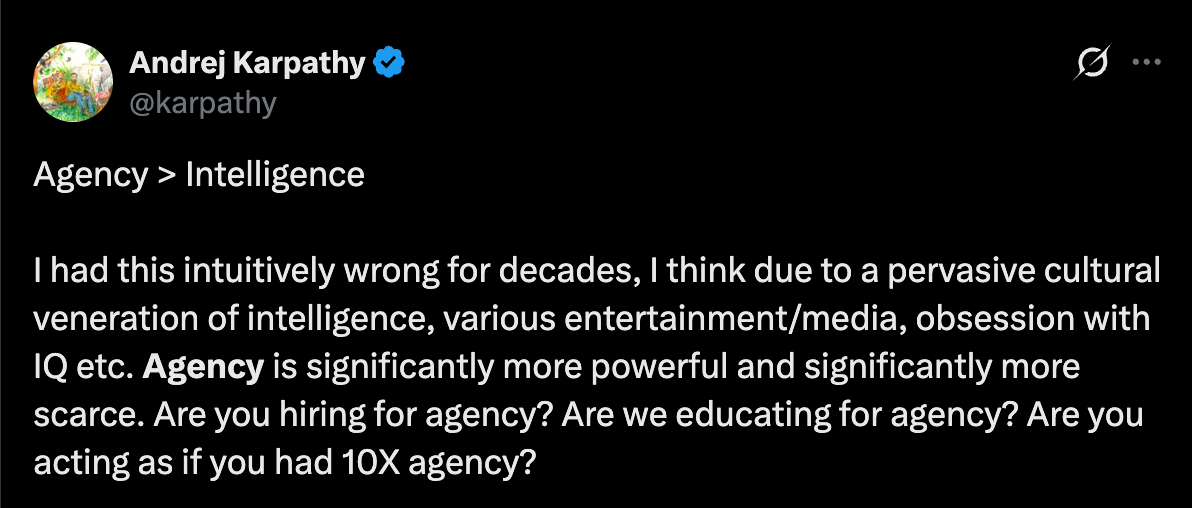
Agency is the ability to take initiative, make decisions, and exert control over your environment. It’s the difference between saying “I’m blocked” and saying “I’ll figure it out.”
In 2026, I want to continue focusing on being high-agency, and build teams that have extreme agency. The speed of execution is effectively infinite now. The bottleneck isn’t code; it’s decision-making. We need builders who can say, “I’ll figure it out,” and then actually do it.
On a personal note…
Agency isn’t just a professional asset; it’s the difference between a life lived by default and a life lived by design.
I have a brother-in-law with a simple rule for family vacations: every day, we get out and do one active thing together. No matter what. Even if we’re tired. Even if the weather sucks. We hike, we swim, we build a snow fort, or we just go to the zoo. The result? We end the day feeling accomplished, and those moments become our core memories. Agency is the force that overcomes the inertia of sitting on the couch.
On the flip side, I know what happens when you lack that foresight. I once spent over 30 hours on a bus traveling across Chile and Argentina, simply because we didn’t plan ahead to book a flight from Punta Arenas to Bariloche. It was… character-building. But it was a stark reminder that the best experiences—the amazing trips, the unforgettable parties—don’t just “happen.” They are engineered by someone who takes ownership.
Taking the initiative is the difference between living a life that simply happens to you, and living a life full of magic moments. That is the energy I want to bring to 2026.
3. Cultivating Product Intuition
There’s always been a lot of talk about data-driven decisions, but in a world where AI can generate infinite data and code, the ultimate differentiator is Product Intuition.
Intuition isn’t magic or a lucky guess. As Shopify’s Tobi Lütke puts it, it’s a “Neo in the Matrix” moment - the ability to look at a complex problem and suddenly see the entire system for what it is, and more importantly, what it could be.
Think of it like a tennis pro. They don’t calculate the physics of the ball mid-play; they just swing. They’ve put in the reps. A seasoned builder develops that same muscle memory. You can physically feel when a user flow is elegant, or when a feature should exist.
This often shows up as an aesthetic signal or a “sense”. Sometimes a solution technically “works” or a feature could be “added on,” but it feels fundamentally wrong. That feeling is your gut computing a trade-off faster than your verbal brain can articulate it.
In 2026, I am focusing on two ways to sharpen this internal model:
Broaden the Training Data: You cannot develop good taste in a vacuum. Grandmaster chess players study thousands of games to recognize winning patterns instantly. Builders need to be obsessive consumers of products. My goal for 2026 is to use more products - not just to see what they do, but to feel how they solve problems. I want to build a mental library of magic moments and friction points to train my own intuition.
Decoding the Vibe: Intuition is the starting point, but the job of a leader is to “unearth and decode” that signal. I want to get better at moving from “I don’t like this” to “I don’t like this because we are violating this specific primitive of the user experience.”
If Build to Learn is about understanding the technology, Product Intuition is about developing the taste to know if what you’ve built is actually worth existing. My goal for 2026 is to hone this taste by surrounding myself with people who challenge my “aesthetic logic” and by continuing to put in the reps.
4. Write to Think
Finally, there is this blog.
I don’t write because I want to be a definitive source of truth. I write because it helps me think. If building is how I learn by doing, writing is how I learn by thinking. This blog isn’t just an exercise in sharing what I already know; it’s an exercise in figuring out what I actually believe.
We live in a world of information overload. Writing forces me to slow down, structure my thoughts, and clarify my own convictions. It helps me lead my team, communicate ideas, and make better decisions. It also helps me engage with the community and all of you, which, in turn, opens me up to new ideas and different ways of thinking about something. THANK YOU to everyone who has helped shape my thinking over the years.
If “Build to Learn” is how we understand the technology, “Write to Think” is how we understand the strategy.
5. Stay Curious
The rate of change right now is uncomfortable. When things move this fast, it is very easy to retreat into what you already know. But in 2026, comfort is a trap.
The “experts” of tomorrow are simply the people who remain curious today. I want to hold onto that feeling of being a beginner - the slightly scary, exhilarating feeling of opening a new tool (like I did with Vercel and AI Studio this break) and asking, “What if?”
Curiosity is the fuel for agency. It’s what drives you to build to learn. It’s the antidote to the fear of the unknown. As long as we stay curious, the fog of the future looks less like a threat and more like an invitation.
The Year of Tensions
If 2025 was the year of the breakthrough, I think 2026 will be the Year of Tensions.
We are going to have to navigate some difficult balances:
Thrash vs. Agility: How do we pivot fast without burning out the team?
Agency vs. Oversight: How do we empower people to move fast without losing coherence?
Writers vs. Editors: How do we balance the “Writers” (the builders creating the raw work) with the “Editors” (leadership providing the polish and direction)?
My Commitments for 2026
So, for 2026, I’m ditching the AI bingo card. I can’t predict the future, but I can commit to a set of principles for navigating it.
My guiding lights for the year ahead are:
Build to learn: Prioritize doing over just theorizing.
Have high agency: Be proactive, take initiative, and own the path forward.
Hone my intuition: Cultivate the product taste that comes from experience, failure, and deep engagement.
Write to think: Use writing as a tool to clarify and challenge my own ideas.
Stay Curious: Reject comfort, embrace the beginner’s mind, and treat the future as an invitation.
Navigate the tensions: Acknowledge and balance the constant push-and-pull between empowering teams and providing oversight, and between making agile pivots and falling into directionless thrash.
I’m excited to see what we’ll build, what we’ll learn, and how our own workflows and expectations will evolve. The world is changing fast, and I plan to be an active participant in shaping what comes next. I hope you will be, too.
'Taking the initiative is the difference between living a life that simply happens to you, and living a life full of magic moments. That is the energy I want to bring to 2026.'
Agency beats intelligence every time when the world's moving this fast.
That bus trip across Chile is the perfect example. All the planning ability in the world doesn't matter if you don't act on it. The magic moments never just happen.
I'm exploring how organizations build agency at scale: https://vivander.substack.com/p/the-2026-ai-career-playbook-six-skills